
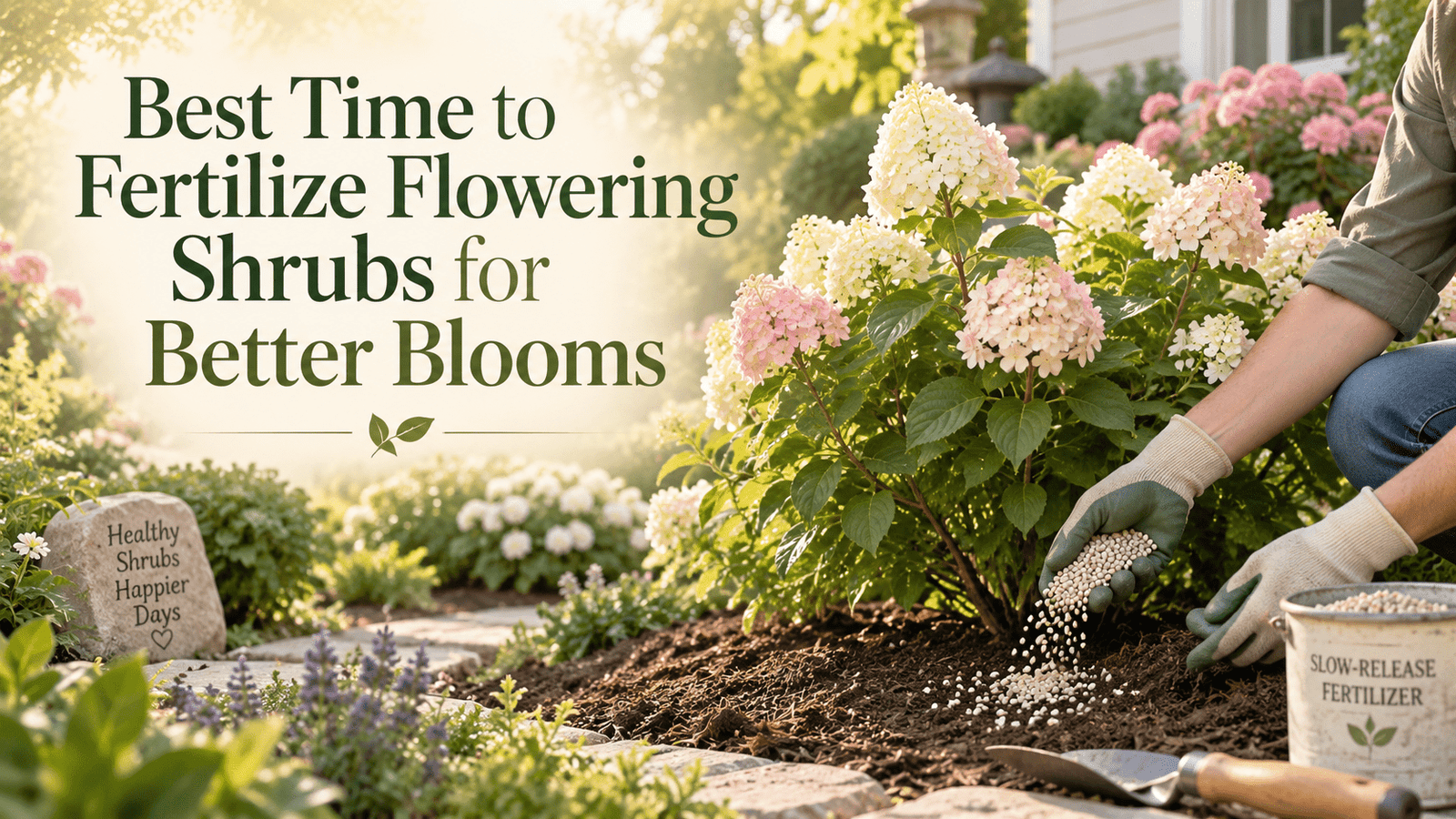
Knowing the best time to fertilize flowering shrubs can make a noticeable difference in how well they grow and bloom during the season. Fertilizer works best when plants are actively growing and able to use the nutrients you are giving them.
For most flowering shrubs, that means feeding them in early spring as new growth begins.
Here at Bobby & Lynn’s Plant Farm, we prefer using a slow-release fertilizer because it keeps the job simple. Instead of remembering several fertilizer applications throughout spring and summer, one properly timed application can provide nutrients gradually over the growing season.
Quick Answer: Best Time to Fertilize Flowering Shrubs
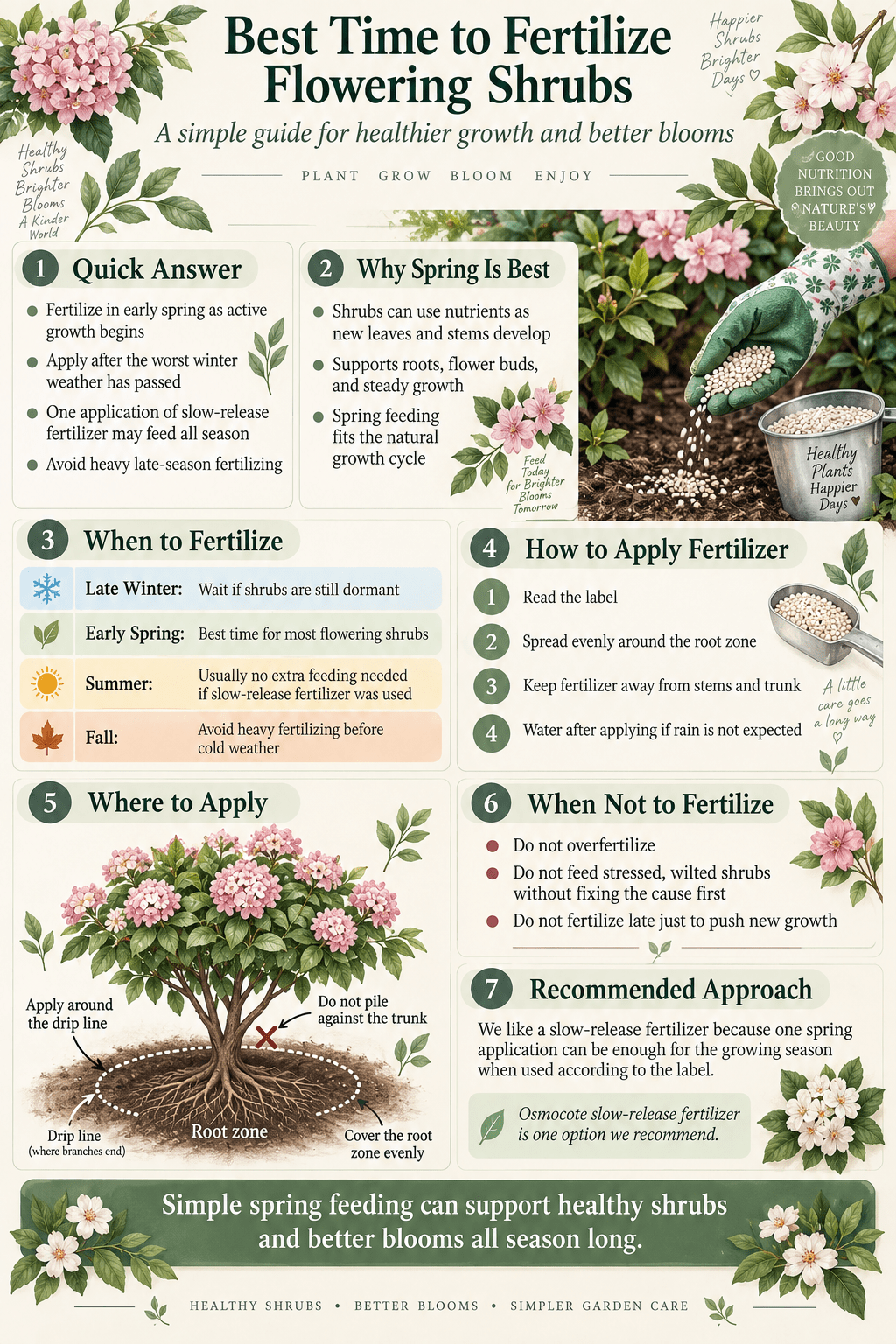
The best time to fertilize flowering shrubs is generally in early spring, just as the plants begin waking up and producing new growth.
Apply fertilizer after the worst winter weather has passed and the soil is beginning to warm.
For most established flowering shrubs, one application of a quality slow-release fertilizer in spring may be all they need for the growing season.
Avoid fertilizing late in the year when new growth may not have enough time to harden before cold weather arrives.
Why the Best Time to Fertilize Flowering Shrubs Is Spring
Spring is when most flowering shrubs begin shifting from winter dormancy into active growth.
Roots become more active, buds begin swelling, and new stems and leaves start developing.
This is when fertilizer can be particularly useful.
Applying nutrients at the beginning of the growing season gives the plant access to what it needs while producing:
- New stems
- Fresh leaves
- Flower buds
- Roots
- New branches
Fertilizing too early, while the ground is still very cold and the plant is dormant, usually does not provide much benefit.
Waiting until new growth begins gives you a much better indication that the shrub is ready.
What Month Is the Best Time to Fertilize Flowering Shrubs?
There is no single month that works everywhere.
The best time to fertilize flowering shrubs depends partly on your climate.
Warmer Climates
In warmer areas such as Georgia and much of the Southeast, flowering shrubs may begin growing fairly early.
Depending on the weather, fertilizer may be applied sometime around late February through March.
We prefer watching the plants rather than fertilizing simply because the calendar reaches a certain date.
If buds are swelling and new growth is beginning, the plant is telling you the season is getting started.
Colder Climates
Gardeners farther north may need to wait until March, April, or even later.
If your shrubs are still fully dormant and the ground remains very cold, there is usually no reason to rush.
Wait until spring growth starts becoming noticeable.
Our Favorite Fertilizer for Flowering Shrubs
We prefer keeping fertilizer simple.
For many of our flowering shrubs, we recommend Osmocote slow-release fertilizer.
The big advantage is convenience.
Instead of applying fertilizer repeatedly throughout the growing season, the nutrients are released gradually over time.
For the Osmocote slow-release fertilizer we recommend, one spring application can generally provide feeding through the growing season when applied according to the package directions.
You can see the Osmocote slow-release fertilizer we recommend.
Affiliate Disclosure: As an Amazon Associate, Bobby & Lynn’s Plant Farm may earn from qualifying purchases at no extra cost to you.
Why We Like Slow-Release Fertilizer for Flowering Shrubs
Slow-release fertilizers provide nutrients gradually instead of delivering everything at once.
That has several advantages.
It makes fertilizing easier to remember.
It also reduces the temptation to keep adding fertilizer every few weeks because you are worried the plant needs more.
More fertilizer is not always better.
Too much can encourage excessive leafy growth, damage roots, or result in a plant that grows vigorously but does not necessarily produce better flowers.
A slow-release product gives the shrub a more gradual supply of nutrients during active growth.
How to Apply Fertilizer to Flowering Shrubs
Always begin by reading the fertilizer label.
The amount you need can vary depending on:
- The fertilizer formula
- The size of the shrub
- Whether the plant is established or newly planted
- Whether the shrub is growing in the ground or a container
Spread granular fertilizer evenly around the root zone rather than dumping it directly against the trunk or stems.
Think about the area underneath and slightly beyond the branches of the shrub.
That is where many of the actively growing feeder roots are located.
After applying the fertilizer, water the area if rain is not expected.
This helps begin moving nutrients into the soil.
When Is the Best Time to Fertilize Newly Planted Flowering Shrubs?
New shrubs deserve a little extra caution.
We usually do not recommend throwing a large amount of fertilizer on a newly planted shrub just because it has gone into the ground.
The first priority is establishing healthy roots.
If the soil has been properly prepared and the plant is growing normally, heavy fertilization may not be necessary immediately.
Follow the recommendations for the particular plant and fertilizer you are using.
During the first season, consistent watering is often much more important than trying to push rapid top growth.
Should You Fertilize Flowering Shrubs Before They Bloom?
Usually, yes.
For shrubs that bloom later in spring or summer, fertilizing as spring growth begins gives the plant access to nutrients well before flowering.
You do not need to wait until flowers appear.
In fact, the plant is already spending energy developing new stems, leaves, roots, and flower buds before you ever see the first bloom.
That is one reason early spring is such a useful fertilizer window.
Should You Fertilize Flowering Shrubs While They Are Blooming?
You usually do not need to add more fertilizer simply because a shrub has started flowering.
If you already applied a slow-release fertilizer in spring, it should still be providing nutrients.
Adding another dose every time flowers appear can result in overfertilizing.
Watch the plant rather than automatically reaching for another bag of fertilizer.
Healthy leaves, steady growth, and normal flowering are signs that the shrub may already be getting what it needs.
The Best Time to Fertilize Flowering Shrubs That Bloom in Spring
Spring-flowering shrubs can be a little confusing because some begin blooming before they produce much foliage.
You can still fertilize them as active spring growth begins.
There is usually no need to fertilize extremely early just because the plant will be blooming soon.
Allow the shrub to begin waking naturally.
Once the soil warms and growth begins, apply your spring fertilizer according to the label.
The Best Time to Fertilize Flowering Shrubs That Bloom in Summer
Summer-blooming shrubs generally benefit from that same early-spring feeding.
Plants such as panicle hydrangeas, butterfly bushes, and Rose of Sharon produce substantial new growth during spring before flowering later in the season.
Providing nutrients as that growth begins gives them a good foundation for the months ahead.
If you are using a slow-release fertilizer, you usually do not need to keep adding fertilizer throughout summer.
Should You Fertilize Flowering Shrubs in Summer?
Sometimes, but not automatically.
If you used a season-long slow-release fertilizer in spring, another summer application usually is not necessary.
If a shrub appears unhealthy, do not immediately assume fertilizer is the answer.
Problems such as these can look like nutrient deficiencies:
- Too much water
- Too little water
- Poor drainage
- Root damage
- Heat stress
- Disease
- Insects
- Incorrect soil pH
Figure out what is actually wrong before adding more fertilizer.
Should You Fertilize Flowering Shrubs in Fall?
We generally avoid heavy fertilization late in the growing season.
Fertilizer can encourage tender new growth.
If that new growth appears shortly before freezing weather, it may not have enough time to harden properly.
By late summer and fall, we prefer allowing many flowering shrubs to begin slowing down naturally.
There can be exceptions depending on the plant, climate, soil conditions, and fertilizer being used, but routine heavy fall feeding is usually unnecessary.
Can You Fertilize Flowering Shrubs Too Much?
Absolutely.
One of the easiest gardening mistakes to make is assuming that if a little fertilizer helps, more must help even more.
It does not work that way.
Too much fertilizer can cause:
- Excessive leafy growth
- Weak stems
- Root damage
- Fertilizer burn
- Fewer flowers
- Salt buildup in the soil
Always follow the product label.
Do not double the amount because you want twice as many flowers.
Plants do not bargain that way.
Do All Flowering Shrubs Need Fertilizer Every Year?
Not necessarily.
A healthy shrub growing in good soil may need very little supplemental fertilizer.
Before fertilizing, look at the plant.
Is it growing normally?
Does the foliage have good color?
Is it flowering well?
If the answer is yes, there may be no reason to push additional growth.
Soil testing can also help determine whether your soil actually needs additional nutrients.
Fertilizer should supplement what the plant needs, not become an automatic treatment for every shrub in the yard.
Best Time to Fertilize Flowering Shrubs in Containers
Container-grown shrubs are a little different.
Water moves through potting mix more frequently and can carry nutrients with it.
That means container plants may require a different fertilizer schedule than shrubs growing in the ground.
If you are using a slow-release fertilizer, follow the container directions on the product label.
Also remember that plants growing in containers often dry out much faster than plants growing in the landscape.
Watering and fertilizer need to work together.
Watering After You Fertilize Flowering Shrubs
Water plays an important role after fertilizer is applied.
Granular fertilizer needs moisture to begin releasing nutrients into the soil.
If rain is expected soon, nature may handle that job for you.
Otherwise, water the root zone after application.
Avoid applying fertilizer to extremely dry, stressed plants and then leaving them without water.
Get the plant properly hydrated first.
Mulch and Fertilizer
If your shrubs are mulched, you can still fertilize them.
Avoid dumping fertilizer into one pile on top of the mulch.
Spread it evenly throughout the root zone.
Depending on the type and depth of mulch, you can gently move some mulch aside, apply the fertilizer, and replace it afterward.
Keep mulch away from the stems and trunk of the shrub.
A mulch volcano is not doing your plant any favors.
Common Mistakes With the Best Time to Fertilize Flowering Shrubs
Fertilizing Too Early
Do not fertilize while the plant is completely dormant just because you had one warm afternoon in February.
Wait for signs of spring growth.
Fertilizing Too Late
Late-season fertilizer can encourage tender growth shortly before cold weather.
Applying Too Much
Follow the label.
More fertilizer does not guarantee more flowers.
Fertilizing a Stressed Plant
A shrub wilting from heat, drought, root problems, or poor drainage does not necessarily need fertilizer.
Solve the underlying problem first.
Fertilizing Without Knowing What the Plant Needs
Different plants and soils have different nutritional needs.
Pay attention to the shrub rather than treating every plant exactly the same.
A Simple Rule for the Best Time to Fertilize Flowering Shrubs
If you want to keep things simple, remember this:
The best time to fertilize flowering shrubs is generally in early spring as active growth begins.
Use the correct amount, spread it through the root zone, and water it in.
With a good slow-release fertilizer, one properly timed application may be all you need for the growing season.
That is why we like Osmocote.
It keeps one more garden chore off the calendar.
Get Seasonal Plant Care Reminders
Knowing when to fertilize, prune, water, and prepare plants for changing weather can get confusing when you have several different shrubs in the yard.
Our free Garden Help by Bobby & Lynn app was created to make those jobs easier.
You can turn on push notifications for seasonal pruning, watering, fertilizing, extreme heat, and other timely plant-care reminders.
There are no ads and no popups, and you can turn notifications on or off whenever you like.
Final Tips From the Plant Farm
The best time to fertilize flowering shrubs is not determined by one magic date.
Watch the plant.
Watch your weather.
Once spring growth begins, that is usually your signal that it is time.
We prefer using a slow-release fertilizer such as Osmocote because one application keeps feeding the plant gradually instead of requiring us to remember repeated applications throughout the season.
Keep the process simple, follow the label, and remember that healthy plants need more than fertilizer.
Good soil, proper sunlight, drainage, and consistent watering still matter just as much.
Discover more from Bobby and Lynn’s Plant Farm
Subscribe to get the latest posts sent to your email.