
Limelight vs. Endless Summer: Which Hydrangea Is Best?
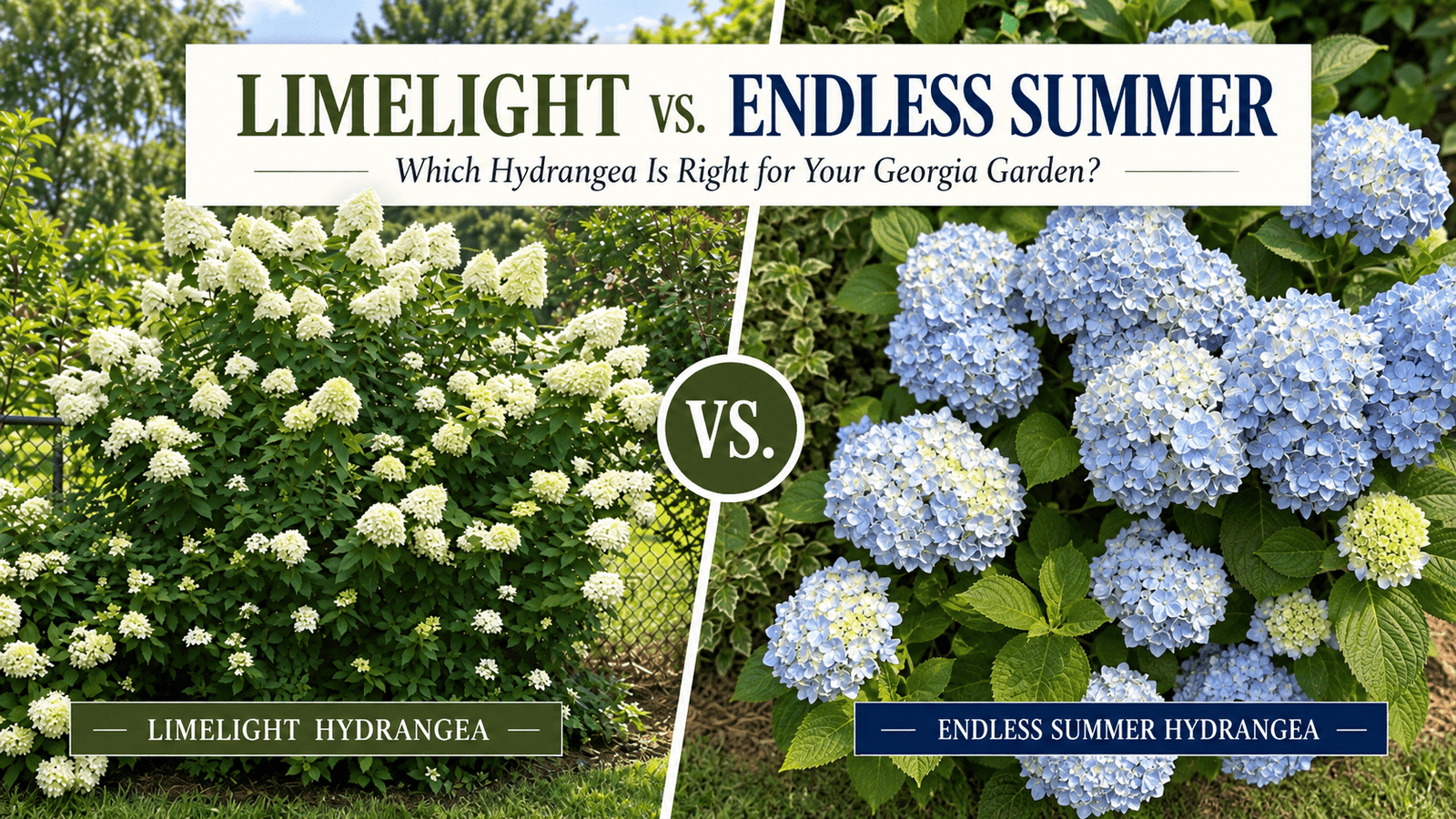
Limelight and Endless Summer are two of the best-known hydrangeas, but they are very different plants.
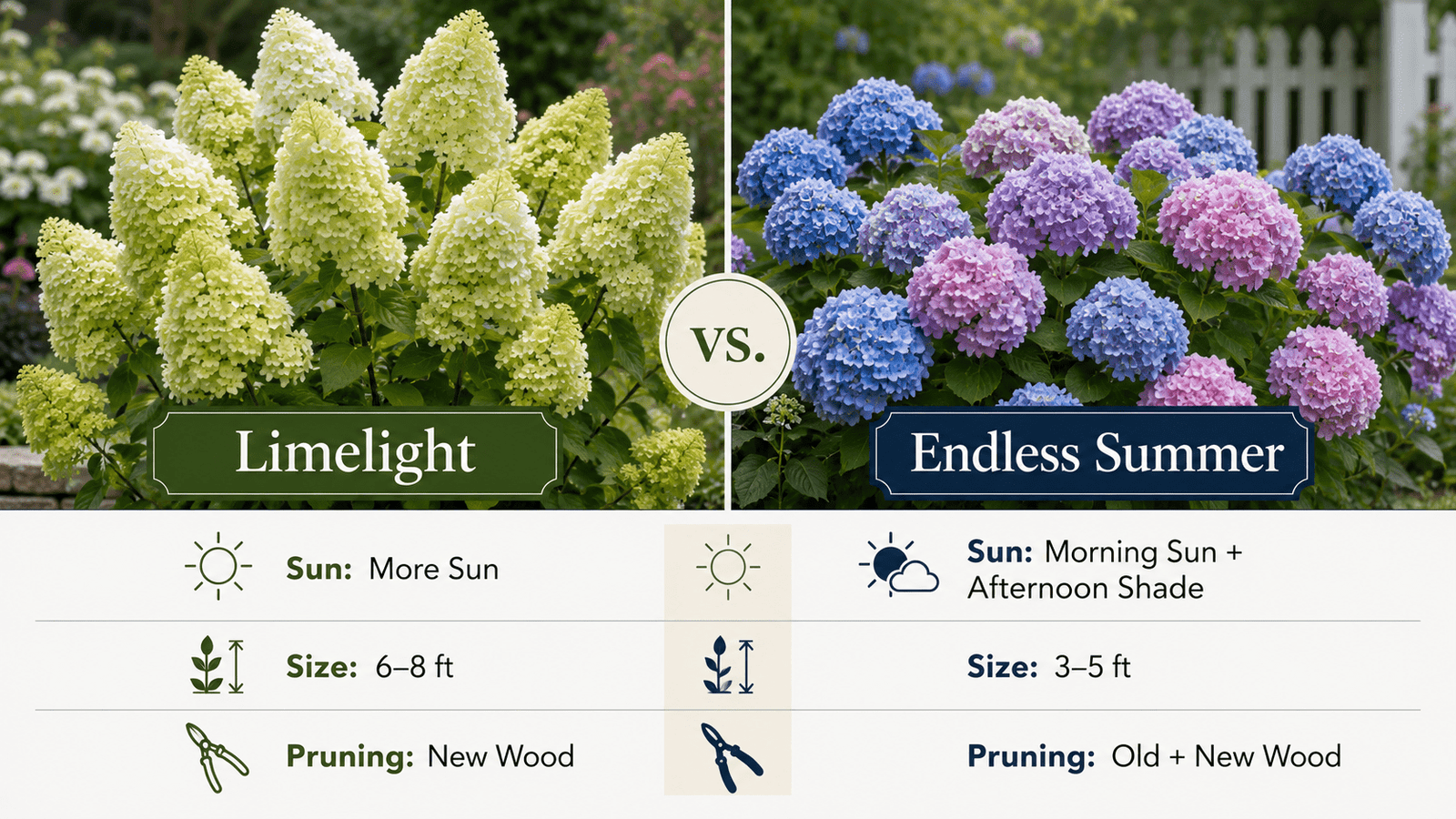
Limelight produces large, cone-shaped flowers and handles more sun. Endless Summer produces rounded blue, pink, or purple blooms and usually performs best with morning sun and afternoon shade.
One is not necessarily better than the other. The right choice depends on where you plan to plant it, how much room you have, and how comfortable you are with pruning and watering.
At Bobby & Lynn’s Plant Farm in Dallas, Georgia, we grow both panicle and bigleaf hydrangeas. Limelight is usually the easier choice for a sunny landscape. Endless Summer can be beautiful in a protected location, but it needs a little more attention during a hot Georgia summer.
Quick Answer
Choose Limelight Hydrangea when you need:
- A larger shrub
- Cone-shaped white, green, and pink flowers
- Better tolerance of direct sun
- Easier pruning
- Dependable flowering on new growth
- A hedge, screen, or large focal point
Choose Endless Summer Hydrangea when you want:
- Rounded mophead flowers
- Blue, purple, or pink blooms
- A more compact shrub
- Morning sun and afternoon shade
- Possible repeat flowering
- A colorful accent near a porch, patio, or shaded border
For many sunny Georgia yards, Limelight is the easier and more dependable option. Endless Summer is better suited to a protected bed where the soil can remain evenly moist.
About Bobby & Lynn

Limelight vs. Endless Summer at a Glance
| Feature | Limelight Hydrangea | Endless Summer Hydrangea |
|---|---|---|
| Hydrangea type | Panicle hydrangea | Reblooming bigleaf hydrangea |
| Botanical name | Hydrangea paniculata ‘Limelight’ | Hydrangea macrophylla ‘Bailmer’ |
| Flower shape | Large cone-shaped panicles | Rounded mophead blooms |
| Flower color | Green, creamy white, pink and rosy tones | Blue, purple or pink |
| Mature size | About 6–8 feet tall and wide | About 3–5 feet tall and wide |
| Sunlight | Part sun to full sun | Morning sun and afternoon shade |
| Blooms on | New wood | Old and new wood |
| Pruning time | Late winter or early spring | Minimal pruning; remove dead wood in spring |
| Heat tolerance | Very good with adequate water | Moderate with afternoon protection |
| Water needs | Moderate and consistent | Consistent moisture |
| Best use | Hedge, screen or large focal point | Shaded border, foundation bed or container |
| Care level | Easy to moderate | Moderate |
Actual size and performance depend on climate, soil, sunlight, watering, and pruning.
What Is Limelight Hydrangea?
Limelight is a panicle hydrangea known for its large, cone-shaped flowers.
The blooms often begin lime green, turn creamy white, and gradually develop pink or rosy shades as the season progresses. Older flowers may remain attractive into fall and winter.
Limelight blooms on new wood. That means its flower buds form on growth produced during the current season.
Because the flowers are not completely dependent on stems that survived the previous winter, Limelight is generally easier to prune and more dependable after cold weather.
The UGA Extension guide to identifying and pruning hydrangeas explains that panicle hydrangeas bloom on new spring growth and may be pruned before that growth begins.
What Is Endless Summer Hydrangea?
Endless Summer is a reblooming bigleaf hydrangea.
It produces the rounded mophead flowers many people picture when they hear the word hydrangea. Flower color may be blue, purple, lavender, or pink depending largely on soil chemistry and the availability of aluminum.
Unlike traditional bigleaf hydrangeas, Endless Summer can produce flowers on both old and new wood.
Old stems may carry the first and strongest round of flowers. New stems can produce additional blooms later in the season.
That makes Endless Summer more forgiving after cold damage or a pruning mistake. However, protecting the old stems still gives the plant its best chance of blooming early and heavily.
Read How to Grow Endless Summer Hydrangea in Georgia for a complete care and troubleshooting guide.
Which Hydrangea Handles More Sun?
Limelight handles more sunlight than Endless Summer.
Limelight sunlight needs
Limelight usually performs well with:
- Morning sun
- Part sun
- Six or more hours of direct light
- Full sun when the soil remains adequately moist
- Some afternoon protection in especially hot locations
More sunlight often encourages stronger stems and heavier flowering. However, reflected heat and dry soil can still stress the plant.
A Limelight growing beside a hot driveway or brick wall may need more water than the same shrub planted in an open bed.
Endless Summer sunlight needs
Endless Summer usually performs best with:
- Morning sunlight
- Bright filtered light
- Afternoon shade
- Protection from hot western exposure
- Consistently moist soil
Too much shade may reduce flowering. Too much afternoon sun may cause wilting, scorched leaves, faded blooms, and repeated moisture stress.
For most Georgia landscapes, an east-facing location is safer than an exposed west-facing bed.
Which Hydrangea Is More Heat Tolerant?
Limelight is generally more heat tolerant.
Panicle hydrangeas can handle more direct sunlight and higher temperatures than bigleaf hydrangeas. That does not mean they can be planted and forgotten.
Limelight still needs adequate moisture, especially while newly planted or growing in full sun.
Endless Summer can grow well in Georgia, but it usually needs protection from the hottest afternoon sun. Its large leaves lose moisture quickly, and the plant may wilt dramatically during summer heat.
Some afternoon drooping is normal when the soil remains moist and the plant recovers by the following morning.
Read Why Hydrangeas Wilt in Summer and How to Fix It before assuming every wilted leaf needs more water.
Which Hydrangea Is Easier to Prune?
Limelight is easier to prune because it blooms on new wood.
How to prune Limelight Hydrangea
Prune Limelight in late winter or early spring before new growth begins.
Start by removing:
- Dead branches
- Broken stems
- Thin or weak growth
- Crossing branches
- Stems growing toward the center
- Branches that make the shrub badly unbalanced
Limelight does not need to be cut close to the ground every year.
Heavy pruning may encourage larger flowers, but it can also produce long, weak stems that bend under the weight of the blooms.
Moderate selective pruning usually creates a stronger and more natural plant.
How to prune Endless Summer Hydrangea
Prune Endless Summer carefully.
Leave the stems in place through winter. Wait until spring growth makes it clear which portions are alive.
Remove:
- Completely dead stems
- Broken branches
- Weak or damaged growth
- Old flowers when desired
Avoid cutting the entire shrub to the ground unless the stems are truly dead.
Even though Endless Summer can bloom on new wood, removing the living old stems may eliminate the first flush of flowers and delay the season.
Which Hydrangea Blooms More Reliably?
Limelight usually blooms more reliably.
Because it flowers on new growth, winter damage is less likely to eliminate the entire bloom season.
Endless Summer can rebloom, but its performance may be affected by:
- Late freezes
- Winter injury
- Too much shade
- Excessive afternoon sun
- Incorrect pruning
- Too much nitrogen
- Dry soil
- A newly planted root system
Endless Summer may produce a beautiful display one year and a lighter display the next.
Limelight is often more predictable, especially in an open sunny landscape.
Flower Shape and Color
The most obvious difference between these hydrangeas is their flowers.
Limelight flowers
Limelight produces elongated, cone-shaped flower clusters.
The blooms commonly progress through several colors:
- Lime green
- Creamy white
- Pale pink
- Deeper rosy or burgundy tones
The exact color depends on weather, sunlight, temperature, and the age of the bloom.
Limelight flower color is not controlled by soil pH in the same way as bigleaf hydrangeas.
Endless Summer flowers
Endless Summer produces large, rounded mophead blooms.
Flower color is influenced by soil chemistry:
- Acidic soil with available aluminum encourages blue flowers.
- Less acidic or alkaline soil usually encourages pink flowers.
- Intermediate conditions may create lavender or purple flowers.
Georgia Piedmont soil is often naturally acidic, so blue and purple shades are common.
Read How to Turn Bigleaf Hydrangeas Blue, Pink, or Purple before changing the soil around your plant.
Which Hydrangea Gets Larger?
Limelight becomes the larger shrub.
A mature Limelight commonly reaches about 6 to 8 feet tall and wide. Under favorable conditions, it may grow even larger.
Endless Summer usually remains around 3 to 5 feet tall and wide.
This difference makes Limelight a better choice for:
- Large foundation beds
- Flowering hedges
- Privacy screens
- Property lines
- Large islands
- Background plantings
Endless Summer fits more easily into:
- Smaller flower beds
- Shaded foundation areas
- Patio borders
- Mixed shrub beds
- Large containers
- Areas beneath high tree canopies
Always plan for the mature width.
A Limelight may look small in its nursery pot, but planting it two feet from a walkway can create a future pruning problem.
Which Hydrangea Needs More Water?
Both hydrangeas need regular water while they become established.
Endless Summer generally needs more consistent moisture because its large leaves lose water quickly during heat.
Limelight is somewhat more forgiving once established, but it should not be treated as a drought-tolerant shrub.
During the first growing season:
- Check the original root ball regularly.
- Water slowly and deeply.
- Avoid light surface sprinkling.
- Add two to three inches of mulch.
- Keep mulch away from the stems.
- Adjust watering for rainfall and soil conditions.
- Avoid keeping heavy clay constantly wet.
Container-grown root balls can dry at a different rate from the surrounding Georgia clay.
The ground around the plant may feel moist while the original potting mix is already dry.
Which Hydrangea Is Better for Georgia Clay?
Both can grow in Georgia clay when the site drains properly.
Set the top of the root ball level with or slightly above the surrounding soil. This helps prevent water from collecting over the roots.
Do not dig a deep planting hole and fill it with loose amended soil. That can create a bowl that holds water around the root ball.
Instead:
- Dig a wide hole.
- Keep the planting depth shallow.
- Loosen the surrounding clay.
- Backfill mainly with the original soil.
- Water slowly.
- Add mulch over the root area.
- Avoid low spots that remain soggy.
Endless Summer usually struggles sooner when drainage is poor. Limelight is tough, but constantly saturated soil can damage it too.
Which Hydrangea Is Better for a Hedge?
Limelight is usually the better hedge plant.
Its larger size, upright habit, and dependable flowering make it useful for:
- Flowering privacy screens
- Property lines
- Large borders
- Background plantings
- Informal hedges
Allow enough room between plants for mature width and airflow.
Endless Summer can be planted in groups, but it usually creates a lower and softer border rather than a tall screen.
Which Hydrangea Is Better Near a House?
That depends on the available space and sunlight.
Endless Summer may be the better choice near a house when:
- The bed receives morning sun.
- The area has afternoon shade.
- The planting space is relatively small.
- You want blue, pink, or purple flowers.
Limelight may be the better choice when:
- The bed is large.
- The location receives more sunlight.
- There is room for a 6- to 8-foot shrub.
- You want a bold flowering focal point.
Avoid planting either hydrangea directly beneath a roofline without considering runoff.
Heavy water pouring from a roof can wash away mulch, saturate the root zone, and damage flowers.
Which Hydrangea Is Better in a Container?
Endless Summer is usually easier to grow in a large container because it stays smaller.
Use a substantial container with drainage holes and enough room for root growth.
Container hydrangeas dry much faster than shrubs planted in the ground. Check moisture frequently during summer.
Limelight can be grown in a large container temporarily, but its mature size makes it difficult to maintain in an ordinary pot.
A smaller panicle hydrangea such as Little Lime or Bobo may be a better long-term container choice.
Which Hydrangea Attracts More Pollinators?
Not every hydrangea flower offers the same amount of pollen and nectar.
The large decorative florets that make mophead hydrangeas attractive are not the primary food source for pollinators.
Panicle hydrangeas contain many fertile flowers within their clusters and may attract more insect activity, depending on the cultivar.
Neither plant should be the only pollinator resource in a garden.
Add companion plants such as:
- Bee balm
- Coneflowers
- Black-eyed Susans
- Native asters
- Foamflower
- Columbine
- Goldenrod
Our guide to the best companion plants for hydrangeas in Georgia includes suggestions for both sunny and shaded beds.
Common Limelight Hydrangea Problems
Floppy stems
Stems may bend because of:
- Heavy pruning
- Excessive fertilizer
- Too much shade
- Large rain-soaked flowers
- Weak young growth
Avoid cutting the plant too hard every year. Moderate pruning usually produces sturdier stems.
Few flowers
Possible causes include:
- Deep shade
- Too much nitrogen
- A newly planted shrub
- Severe stress
- Excessive pruning after new growth begins
Brown flowers
Limelight blooms naturally age and turn brown.
Premature browning may also result from extreme heat, dry soil, hot wind, or repeated overhead watering.
Leaf scorch
Brown leaf edges may develop when the plant receives intense sun without enough moisture.
Check the soil and consider whether nearby pavement or brick is reflecting additional heat.
Common Endless Summer Problems
No flowers
Common causes include:
- Old stems were removed
- Late freezes damaged buds
- Too much shade
- Too much nitrogen
- Dry soil
- A newly established plant
Read Why Is My Hydrangea Not Blooming? for a complete troubleshooting guide.
Afternoon wilting
Bigleaf hydrangeas often droop during hot afternoons.
Check the soil before watering. Constantly wet clay can cause root damage that also makes a plant wilt.
Brown leaf edges
Brown edges may indicate:
- Strong afternoon sun
- Dry soil
- Hot wind
- Fertilizer burn
- Root stress
- Reflected heat
Leaf spot
Warm, humid weather can encourage fungal leaf spots.
Improve airflow, water near the soil, and clean up heavily affected fallen leaves.
What We See at Our Plant Farm
At Bobby & Lynn’s Plant Farm, we often see people choose a hydrangea based entirely on flower color.
That is understandable. Those flowers can be hard to resist.
Still, the planting location should make the final decision.
A blue Endless Summer may be beautiful, but it is not the best choice for an open bed receiving harsh western sun. Limelight may handle that location better, provided it receives enough water.
On the other hand, Limelight can become far too large for a narrow foundation bed. Endless Summer may fit that protected space much more comfortably.
We also see pruning create unnecessary problems.
Limelight is sometimes cut nearly to the ground every year in hopes of producing huge flowers. The plant may respond with long, weak stems that flop after summer rain.
Endless Summer is sometimes cut back while dormant because the bare stems look dead. That can remove living wood and the buds responsible for the earliest flowers.
The easiest hydrangea to grow is usually the one that naturally fits the space.
Limelight or Endless Summer: Which Should You Choose?
Limelight may be the better choice when:
- The planting area receives plenty of sun.
- A larger shrub will fit the space comfortably.
- Dependable flowering is a top priority.
- Simple late-winter pruning sounds more manageable.
- Cone-shaped blooms in green, white, and pink suit your garden style.
- A flowering hedge or screen is needed.
- The landscape is open, sunny, and exposed to Georgia heat.
Endless Summer may be a better fit when:
- The site receives morning sun and afternoon shade.
- Blue, purple, or pink mophead flowers are the look you prefer.
- A smaller hydrangea fits the available space better.
- Steady summer moisture can be provided.
- A colorful shrub is needed near a porch, patio, or protected foundation bed.
- Careful pruning is not a problem.
- Some variation in repeat flowering from year to year is acceptable.
Frequently Asked Questions
Is Limelight easier to grow than Endless Summer?
For many Georgia homeowners, yes.
Limelight handles more sun, blooms on new wood, and is easier to prune. Endless Summer needs more afternoon protection and careful moisture management.
Can Limelight and Endless Summer be planted together?
They can be planted in the same large bed when the location provides enough sunlight for Limelight without giving Endless Summer harsh afternoon exposure.
A bed with morning sun and bright filtered afternoon light may work.
Allow plenty of space because Limelight becomes considerably larger.
Which one blooms longer?
Both can provide a long season of interest.
Limelight flowers remain attractive as they change from green to white and pink. Endless Summer may produce more than one flush of flowers under good conditions.
Repeat blooming is not guaranteed to be equally heavy every year.
Which hydrangea changes color with soil pH?
Endless Summer.
Its flowers may be blue, purple, or pink depending on soil chemistry and aluminum availability.
Limelight’s seasonal color change is controlled mainly by bloom maturity, weather, and temperature.
Can Endless Summer grow in full sun?
It may tolerate full sun in cooler climates.
In Georgia, morning sun and afternoon shade are usually safer. Strong afternoon sun can cause repeated wilting and leaf scorch.
Can Limelight grow in shade?
Limelight tolerates partial shade, but deep shade may reduce flowering and create weaker stems.
It generally blooms best with several hours of direct sunlight.
When should Limelight be pruned?
Prune in late winter or early spring before new growth begins.
Remove dead, damaged, crossing, and weak branches. Avoid cutting the entire plant back severely every year.
When should Endless Summer be pruned?
Remove dead stems in spring after new growth shows which portions survived winter.
Avoid routine hard pruning because living old stems may hold flower buds.
Credible Sources
We grow both Limelight and Endless Summer hydrangeas at our plant farm, but we also compare what we see with reliable horticultural guidance.
UGA Extension – Identify Hydrangeas to Know When to Prune explains that panicle hydrangeas like Limelight bloom on new spring growth, while reblooming bigleaf hydrangeas such as Endless Summer can bloom on both old and new wood.
NC State Extension – Limelight Hydrangea covers Limelight’s mature size, sunlight needs, bloom color, and pruning requirements.
What to Do Next
Study the planting location before choosing between Limelight and Endless Summer.
Look at the amount of sunlight, when the strongest sun arrives, how quickly the soil dries, and how much space the plant will have at maturity.
Choose Limelight for a sunny, open area where a large flowering shrub has room to grow.
Choose Endless Summer for a smaller, protected bed with morning sun, afternoon shade, and dependable moisture.
Both hydrangeas can be beautiful in Georgia. The difference is putting each one where it naturally performs best.
Visit our Hydrangea Care Guide for more help with planting, watering, pruning, and bloom problems.
Discover more from Bobby and Lynn’s Plant Farm
Subscribe to get the latest posts sent to your email.