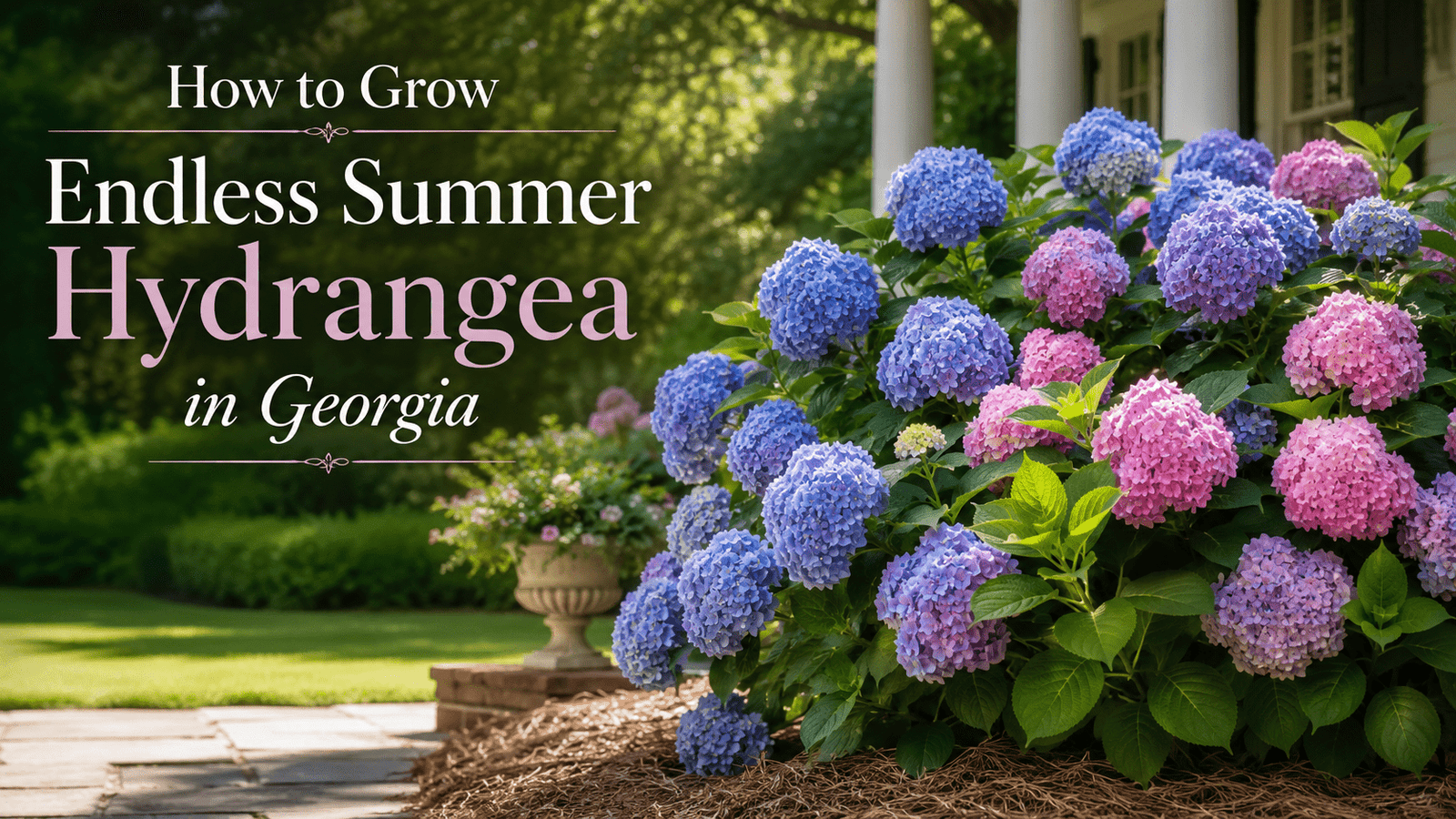
Endless Summer Hydrangea is known for its large mophead flowers in shades of blue, pink, and purple. It can also bloom more than once during the growing season, which sounds mighty appealing when you’re trying to keep a Georgia landscape colorful through summer.
Still, Endless Summer is not always as carefree as its name suggests.
It needs the right amount of sunlight, steady moisture, careful pruning, and a little patience. Plant it in harsh afternoon sun or cut it back at the wrong time, and you may end up with plenty of green leaves but very few flowers.
At Bobby & Lynn’s Plant Farm in Dallas, Georgia, we’ve found that planting location and watering make a tremendous difference with bigleaf hydrangeas. Give Endless Summer morning sun, protection from the hottest part of the day, and soil that stays evenly moist, and it has a much better chance of showing off.
Quick Answer
To grow Endless Summer Hydrangea successfully in Georgia:
- Plant it where it receives morning sun and afternoon shade.
- Keep the soil evenly moist but never constantly soggy.
- Add two to three inches of mulch around the root area.
- Avoid cutting the entire shrub back in fall or early spring.
- Remove only dead stems after you can clearly see new growth.
- Fertilize lightly in spring rather than feeding heavily.
- Protect developing buds from late freezes when possible.
- Give the plant time to become established.
Endless Summer can bloom on both old and new wood. However, protecting the old stems usually gives you the best chance of an earlier and fuller first round of flowers.
Endless Summer Hydrangea Plant Details
| Plant feature | What to expect |
|---|---|
| Botanical name | Hydrangea macrophylla ‘Bailmer’ |
| Hydrangea type | Reblooming bigleaf hydrangea |
| Mature size | About 3 to 5 feet tall and wide |
| Sunlight | Morning sun and afternoon shade |
| Bloom time | Early summer with possible repeat blooms |
| Flower color | Blue, purple, or pink depending on soil conditions |
| Soil | Moist, rich, and well drained |
| Pruning needs | Light pruning only when necessary |
| Cold hardiness | Generally hardy in USDA Zones 4–9 |
| Care level | Moderate |
The mature size can vary depending on climate, sunlight, soil, pruning, and growing conditions.
What Makes Endless Summer Hydrangea Different?
Traditional bigleaf hydrangeas usually form flower buds on stems produced during the previous growing season. Those stems are called old wood.
When old-wood hydrangeas are cut back during fall, winter, or early spring, the next season’s flower buds may be removed before they ever have a chance to open.
Endless Summer is different because it can bloom on both old wood and new wood.
Old stems may produce the first flowers of the season. Fresh stems growing during spring and summer may produce additional blooms later.
That reblooming ability gives Endless Summer an advantage after cold damage or pruning mistakes. However, it does not mean you can cut the shrub to the ground every year and expect a huge display.
The old stems still matter.
The UGA Extension guide to identifying and pruning hydrangeas explains why knowing whether a hydrangea blooms on old wood, new wood, or both is so important.
How Much Sun Does Endless Summer Hydrangea Need?
In Georgia, Endless Summer Hydrangea usually performs best with morning sun and afternoon shade.
A location receiving four to six hours of sunlight can work well when most of that light comes before the hottest part of the day.
Strong afternoon sun can cause:
- Wilted leaves
- Scorched leaf edges
- Faster moisture loss
- Faded flowers
- Shorter bloom life
- Greater summer stress
A little afternoon wilting does not always mean the shrub needs more water. Bigleaf hydrangeas have large leaves that lose moisture quickly during hot weather.
Check the soil before watering.
When the soil is still moist and the plant recovers after the sun goes down, it may simply be reacting to heat. When it remains wilted the following morning, the root zone may be too dry or another problem may be present.
Read Why Hydrangeas Wilt in Summer and How to Fix It for more help telling the difference between normal heat stress and a hydrangea that truly needs water.
The Best Place to Plant Endless Summer Hydrangea
A good location can prevent many common problems before they start.
Look for an area with:
- Gentle morning sunlight
- Shade during the hottest afternoon hours
- Protection from strong drying winds
- Soil that drains after rain
- Enough room for air to circulate
- Space for the shrub to reach its mature size
The east or northeast side of a house often works well. Filtered light beneath tall trees may also be suitable, provided the hydrangea is not competing heavily with large tree roots.
Avoid planting directly beneath shallow-rooted mature trees. Their roots can pull moisture from the soil before the hydrangea gets much of a chance.
Areas beside hot pavement, brick walls, or driveways may also be tougher than they first appear. These surfaces reflect heat and can dry the soil quickly.
How to Plant Endless Summer Hydrangea
The best time to plant Endless Summer Hydrangea in Georgia is usually fall or early spring.
Cooler weather reduces stress while the roots begin growing into the surrounding soil. Summer planting is possible, but the shrub will need closer attention and more consistent watering.
Step 1: Prepare the planting area
Dig a hole about two to three times wider than the root ball.
The hole should be no deeper than the root ball itself. Planting too deeply can reduce the amount of oxygen reaching the roots and may contribute to decline.
Step 2: Check the roots
Slide the plant from its container and inspect the root ball.
When roots are tightly circling the outside, loosen them gently with your fingers. This encourages them to grow outward instead of continuing to circle.
Step 3: Position the plant correctly
Set the hydrangea in the hole with the top of the root ball level with or slightly above the surrounding ground.
This is especially important in heavy Georgia clay, where water may drain slowly.
Step 4: Backfill the hole
Use the soil that came from the planting hole to fill around the root ball.
Break apart large clumps and firm the soil gently with your hands. Avoid stomping heavily around the roots.
Step 5: Water deeply
Water slowly and thoroughly after planting. This settles the soil and removes large air pockets around the roots.
Step 6: Add mulch
Apply two to three inches of pine straw, shredded bark, wood chips, or another organic mulch over the root area.
Keep the mulch a few inches away from the stems. Mulch piled against the plant can trap moisture and contribute to stem problems.
For more help choosing and caring for hydrangeas, visit our Hydrangea Care Guide.
How Often Should Endless Summer Hydrangea Be Watered?
Endless Summer Hydrangea prefers soil that remains evenly moist.
Newly planted shrubs need closer attention because their roots are still concentrated inside the original root ball. The surrounding soil may feel damp while the root ball itself has already dried out.
During the first growing season:
- Check the soil several times each week.
- Water when the upper few inches begin to feel dry.
- Apply water slowly enough to soak the entire root ball.
- Avoid watering automatically when the soil is already wet.
- Pay extra attention during hot, windy, or rainless weather.
A rigid schedule such as “water every day” or “water exactly twice per week” does not work for every yard.
Clay soil, sandy soil, shade, sunlight, rainfall, temperature, plant size, and drainage all affect how quickly the root zone dries.
Deep watering is generally better than frequent light sprinkling. Shallow watering can encourage roots to remain close to the surface, where they dry out faster.
What We See at Our Plant Farm
One issue we see with container-grown hydrangeas is that the original root ball can dry differently from the surrounding soil.
You may water the flower bed and assume the whole area is moist. However, the potting mix around the original roots may still be dry in the middle.
When a newly planted hydrangea looks wilted, check the actual root ball instead of testing only the loose soil nearby.
We also see bigleaf hydrangeas planted in places that receive far more afternoon sun than expected. A spot may seem partly shaded during spring, but the summer sun can shift and become much stronger.
Watch the location through the day before planting. That little bit of homework can save you a heap of trouble later.
How to Prune Endless Summer Hydrangea
Endless Summer Hydrangea usually needs very little pruning.
Because it can bloom on old and new wood, it is more forgiving than a traditional bigleaf hydrangea. Even so, cutting it back heavily can remove the old stems that would have produced the earliest flowers.
The safest pruning approach
In late winter or early spring:
- Leave the stems in place while the plant is dormant.
- Wait until new leaves begin appearing.
- Look for swelling buds along each stem.
- Remove stems that remain brown, brittle, and lifeless.
- Cut dead wood back to healthy green tissue or to the ground.
- Leave living stems alone unless they are damaged or badly crowded.
Use the scratch test when you are unsure. Lightly scrape a tiny area of bark with your fingernail.
Green tissue beneath the bark usually indicates that the stem is alive. Dry brown tissue may mean that portion is dead.
Do not get impatient and remove every bare stem in February. Bigleaf hydrangeas sometimes wake up slowly, especially after a cold winter.
Can Endless Summer Hydrangea be pruned in fall?
Avoid cutting the entire shrub back in fall.
Old stems may already hold buds for the following year’s first flowers. Removing them can delay blooming and reduce the early display.
You can remove broken branches and faded flowers, but major pruning is rarely necessary.
Should You Deadhead Endless Summer Hydrangea?
You can remove faded flowers during the growing season to keep the shrub looking tidy.
Follow the flower stem down to the first healthy pair of leaves or buds and make your cut just above them.
Do not follow the stem deep into the plant unless you are intentionally pruning and know exactly what you are removing.
Deadheading may encourage a neater appearance and can support reblooming under good conditions. However, it cannot correct poor sunlight, drought stress, freeze damage, or excessive fertilizer.
Read When to Deadhead Hydrangeas: 5 Simple Rules to Follow for more detailed instructions.
How to Fertilize Endless Summer Hydrangea
Endless Summer Hydrangea does not need constant feeding.
Apply a balanced, slow-release fertilizer for flowering shrubs in early spring if the plant needs it. Follow the product label carefully.
A light second feeding may be appropriate in early summer when growth is weak or the soil is low in nutrients. Avoid fertilizing late in the growing season because it may encourage tender growth that does not harden before cold weather.
Too much nitrogen can cause:
- Large green leaves
- Fast, soft growth
- Fewer flowers
- Weak stems
- Greater disease pressure
When the shrub is growing vigorously but not flowering, adding more fertilizer may make the problem worse.
A soil test is the best way to learn whether the soil actually needs lime, sulfur, phosphorus, or another amendment.
How to Change Endless Summer Hydrangea Flower Color
Endless Summer flowers may be blue, purple, or pink depending largely on soil chemistry and the availability of aluminum.
In general:
- Acidic soil with available aluminum encourages bluer flowers.
- Less acidic or alkaline soil usually produces pinker flowers.
- Conditions between those ranges may create purple or mixed colors.
Many soils in the Georgia Piedmont are naturally acidic, so blue or purple flowers are common.
Do not add lime or sulfur without knowing the current soil pH.
Too much of either amendment can damage the plant, affect nearby plants, or create nutrient problems. Flower-color changes also happen gradually rather than overnight.
Read How to Turn Macrophylla Hydrangeas Blue, Pink, or Purple before attempting to change your hydrangea’s flower color.
Why Is My Endless Summer Hydrangea Not Blooming?
Endless Summer is sold as a reblooming hydrangea, but it may not flower heavily every year.
Several conditions can reduce blooming.
1. The old stems were pruned away
Heavy pruning in fall, winter, or early spring may remove the buds responsible for the first flush of flowers.
New growth may still bloom later, but the display can be delayed or reduced.
2. A late freeze damaged the buds
Warm weather may cause buds to begin swelling early. A sudden freeze can then damage those tender buds.
The plant may survive and produce new leaves while the flower buds are lost.
3. The plant receives too much shade
Bigleaf hydrangeas enjoy afternoon shade, but very deep shade may reduce flowering.
Bright morning light gives the plant energy without exposing it to the harshest afternoon heat.
4. The plant receives too much hot sun
A plant struggling to survive intense afternoon heat may have little energy left for producing flowers.
5. Too much fertilizer was applied
Excess nitrogen often produces impressive leaves at the expense of blooms.
6. The shrub is newly planted
A young or recently transplanted hydrangea may focus on root development instead of flowering.
Give it time to settle before deciding something is wrong.
7. The soil becomes too dry
Repeated drought stress can slow growth and interrupt bud development.
Keep the soil evenly moist, especially while new growth and flower buds are forming.
8. The plant needs more time between bloom cycles
Repeat blooming is not always immediate. After the first flowers fade, the plant needs time to grow new stems and develop additional buds.
Read Why Is My Hydrangea Not Blooming? 7 Common Causes for a more complete troubleshooting guide.
Common Endless Summer Hydrangea Problems
Afternoon wilting
Temporary wilting during the hottest part of the day is common.
Check the soil before adding water. When the plant recovers during the evening and looks normal the following morning, heat stress is more likely than severe drought.
Brown flower edges
Flowers may turn brown because of:
- Hot afternoon sun
- Dry soil
- Natural aging
- Strong wind
- Repeated overhead watering
- Sudden temperature changes
Older flowers naturally fade and develop brown edges. Not every brown bloom indicates disease.
Yellow leaves
Yellow foliage may result from:
- Soil that stays too wet
- Poor drainage
- Root stress
- Nutrient problems
- Normal aging of older leaves
- High soil pH affecting nutrient availability
Look at the entire plant and check the soil before applying fertilizer.
Leaf spot
Leaf spot commonly appears during warm, humid weather. Dark spots may develop on the leaves, and heavily affected foliage may fall early.
Help reduce leaf disease by:
- Providing good air circulation
- Watering near the soil
- Avoiding repeated overhead watering
- Cleaning up fallen leaves
- Removing badly affected foliage
- Avoiding overcrowding
A few spotted leaves late in summer usually do not justify spraying the entire yard.
Powdery mildew
Powdery mildew looks like a pale or whitish coating on the foliage.
It is more likely when air circulation is poor and humidity remains high. Give the shrub enough room, avoid crowding it between other plants, and water near the base.
Root rot
Root problems may develop when the soil stays constantly wet.
Symptoms can include wilting despite wet soil, yellowing foliage, weak growth, stem decline, and eventual plant death.
Improving drainage before planting is far easier than trying to save a hydrangea after its roots have begun rotting.
Aphids and spider mites
Small insects may occasionally gather on tender growth or the undersides of leaves.
A strong stream of water can remove light infestations. Before applying an insecticide, identify the pest and determine whether the damage is serious enough to require treatment.
How to Protect Endless Summer Hydrangea in Winter
Endless Summer is cold hardy, but winter weather and late freezes can still damage old stems and flower buds.
To provide a little protection:
- Keep two to three inches of mulch over the root area.
- Avoid pruning the stems in fall.
- Water during prolonged winter drought when the ground is not frozen.
- Protect emerging growth when a late freeze is predicted.
- Plant in a location sheltered from strong winter winds.
Even when the upper stems are damaged, healthy roots may produce new growth in spring. Because Endless Summer can flower on new wood, it may still bloom later in the season.
Endless Summer Hydrangea Care Checklist
Use this checklist when your plant is not performing as expected:
- Does it receive morning sun?
- Is it protected from strong afternoon heat?
- Does the soil drain after rain?
- Is the root ball drying between waterings?
- Is mulch covering the root area?
- Is mulch touching the stems?
- Was the plant cut back recently?
- Did a late freeze damage new buds?
- Has it received too much fertilizer?
- Is the plant newly established?
- Are nearby tree roots competing for moisture?
- Does it have enough airflow?
Correcting the growing conditions often helps more than buying another product.
Frequently Asked Questions
Does Endless Summer Hydrangea bloom all summer?
It can produce more than one flush of flowers, but that does not always mean it will remain covered in blooms every day of summer.
Weather, pruning, sunlight, plant age, moisture, and winter damage all affect reblooming.
Does Endless Summer Hydrangea bloom on old or new wood?
It can bloom on both.
Old wood usually supports the earlier flowers, while new growth may produce later blooms.
Should Endless Summer Hydrangea be cut back every year?
No. Annual hard pruning is unnecessary and may reduce flowering.
Remove dead, damaged, or weak stems after new growth makes it clear which portions survived winter.
Can Endless Summer Hydrangea grow in full sun?
It may tolerate full sun in cooler climates. In Georgia, strong afternoon sun can cause significant heat and moisture stress.
Morning sun with afternoon shade is usually a safer choice.
Why are my flowers blue one year and purple the next?
Changes in soil pH, aluminum availability, fertilizer, water, and root development can affect bloom color.
Different flowers on the same plant may also show slightly different shades.
How long does Endless Summer Hydrangea take to become established?
A hydrangea may need one or more full growing seasons to develop a broad root system.
Continue monitoring moisture closely during its first year, especially through summer.
Can Endless Summer Hydrangea grow in Georgia clay?
Yes, provided the planting area drains adequately.
Set the root ball level with or slightly above the surrounding soil. Avoid planting in low areas that remain soggy after rain.
What We See Most Often at Our Plant Farm
The two biggest problems we see with bigleaf hydrangeas are too much afternoon sun and pruning at the wrong time.
People sometimes plant Endless Summer in an open, sunny bed because the label says it can tolerate sun. That may work farther north, but a Georgia afternoon can be a different story altogether.
We also see healthy shrubs cut nearly to the ground because the bare winter stems looked dead. By the time spring arrives, many of the buds that would have produced early flowers are gone.
Give those stems time to wake up before reaching for the pruners.
Endless Summer is more forgiving than an ordinary old-wood hydrangea, but it still performs best when we work with its natural growth instead of trying to rush it.
What to Do Next
Start with the planting location.
Make sure your Endless Summer Hydrangea receives morning sun, afternoon shade, steady moisture, and enough space for air to move around it. Protect the old stems, prune only when needed, and avoid pushing excessive leafy growth with too much fertilizer.
When something goes wrong, check the soil, sunlight, weather, and pruning history before reaching for another garden product.
With the right care and a little Southern patience, Endless Summer can reward you with large blue, purple, or pink blooms for years to come.
Visit our Hydrangea Help page for more practical troubleshooting, or download our free All About Hydrangeas eBook for help with planting, pruning, watering, flower-color changes, and bloom problems.
Discover more from Bobby and Lynn’s Plant Farm
Subscribe to get the latest posts sent to your email.