
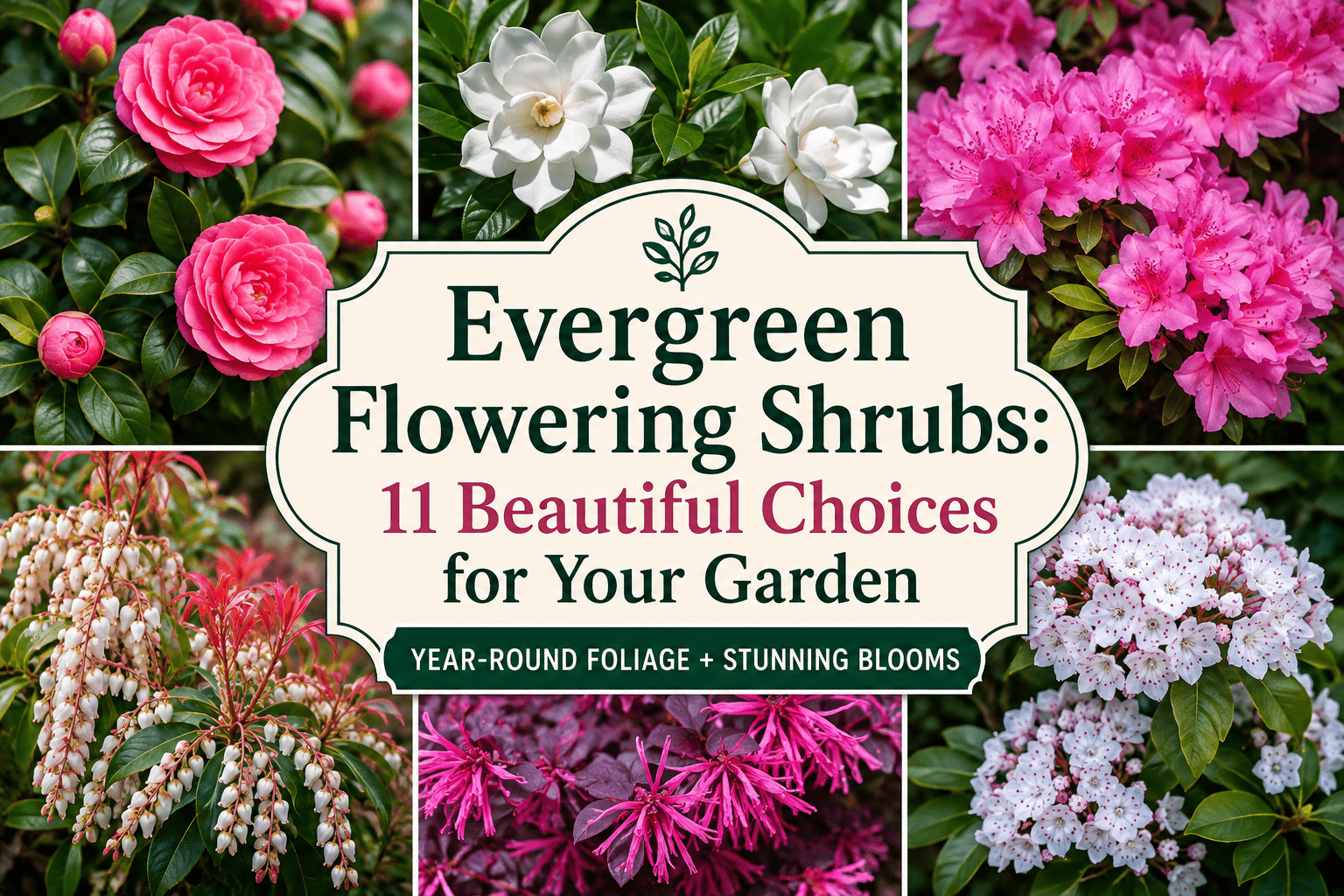
Evergreen flowering shrubs give you two things that are hard to beat in a landscape: year-round foliage and seasonal flowers. Instead of looking at bare branches all winter, you can keep some structure and greenery in the garden while still enjoying colorful blooms when flowering season arrives.
There are evergreen flowering shrubs for sunny beds, partially shaded areas, foundation plantings, woodland gardens, and smaller spaces. The key is choosing one that matches your climate, sunlight, drainage, and available room.
At Bobby & Lynn’s Plant Farm, we always recommend looking beyond the flower picture on the plant tag. Mature size and growing conditions matter just as much as the blooms.
Quick Answer
Some of the best evergreen flowering shrubs to consider include:
- Camellia
- Gardenia
- Evergreen azalea
- Rhododendron
- Japanese pieris
- Mountain laurel
- Loropetalum
- Indian hawthorn
- Winter daphne
- Mexican orange
- Coastal leucothoe
Camellias, gardenias, azaleas, and loropetalum are especially popular in warmer climates. Rhododendrons, mountain laurel, pieris, and leucothoe give gardeners additional options for cooler or partially shaded areas.
Keep in mind that “evergreen” can depend on climate. A shrub that keeps its leaves through winter in a mild area may lose some foliage after severe cold or behave more like a semi-evergreen farther north.
About Bobby & Lynn

Why Evergreen Flowering Shrubs Are So Useful
A good landscape needs more than flowers.
When every plant in a bed is deciduous, the yard can look full and colorful during spring and summer but surprisingly empty once winter arrives.
Evergreen flowering shrubs help solve that problem.
They can provide:
- Winter greenery
- Spring, summer, fall, or winter flowers
- Foundation structure
- Privacy
- Screening
- Pollinator interest
- Fragrance
- A backdrop for perennials and annuals
You don’t need to make the entire landscape evergreen, either. Mixing evergreen and deciduous shrubs usually creates a more natural-looking garden with interest throughout the year.
For additional ideas on building color and structure into a landscape, see our Best Flowering Shrubs for Year-Round Curb Appeal. Best Flowering Shrubs for Year-Round Curb Appeal
11 Evergreen Flowering Shrubs to Consider
The best choice will depend heavily on where you garden. Some of these shrubs love Southern heat, while others perform better where summers are cooler.
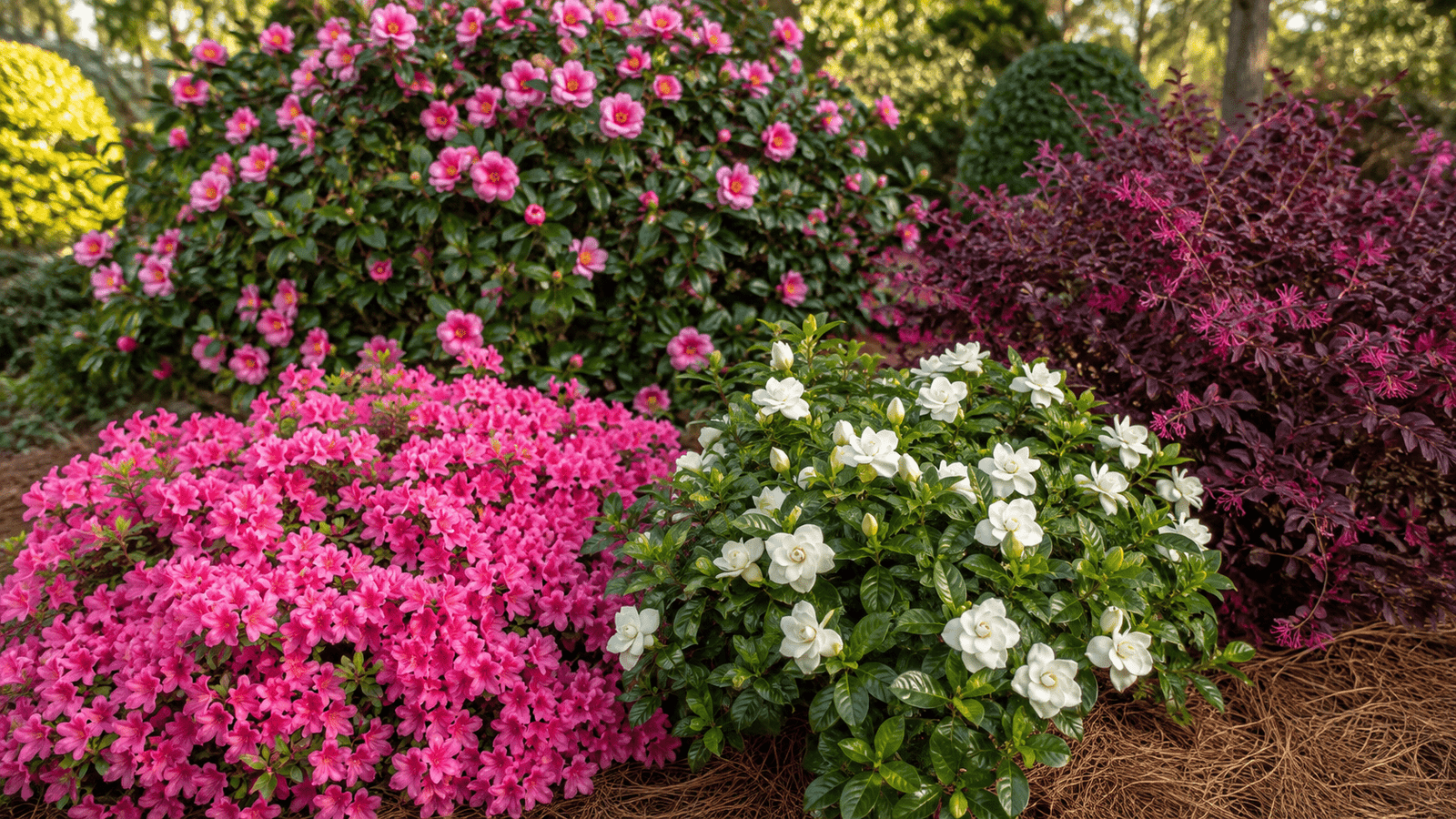
Here are 11 evergreen flowering shrubs worth considering.
1. Camellia
Camellias are one of the first plants that come to mind when we think about beautiful evergreen shrubs.
Their glossy green foliage looks attractive throughout the year, while flowers can appear from fall through early spring depending on the type and cultivar.
Flower colors commonly include:
- White
- Pink
- Red
- Blended shades
There are two common groups gardeners are likely to encounter.
Sasanqua camellias generally flower earlier, often beginning in fall.
Japanese camellias commonly bloom later during winter or early spring.
Camellias usually appreciate well-drained acidic soil and protection from harsh environmental conditions. Many perform beautifully with morning sun, filtered light, or partial shade.
UGA Extension describes camellias as evergreen shrubs and notes that bloom time can extend from fall into spring depending on the type.
For a deeper look at camellia selection and care, Clemson Extension also has an excellent reference. Clemson Extension Camellia Guide
2. Gardenia
Few flowering shrubs can compete with a gardenia for fragrance.
Gardenias produce waxy white flowers against glossy dark green leaves. That combination makes them especially attractive around patios, porches, walkways, and entrances where you can enjoy the fragrance.
Gardenias generally prefer:
- Acidic soil
- Good drainage
- Consistent moisture
- Sun to partial shade
- Protection from severe winter temperatures
There are also large and compact cultivars, so don’t assume every gardenia will reach the same size.
Gardenias are among the evergreen flowering shrubs that are especially useful in warmer growing regions. UGA Extension notes that gardenias are evergreen and available in a wide range of sizes.
3. Evergreen Azalea
Azaleas are one of the classic flowering shrubs of the Southeast, but there’s an important distinction to understand.
Not every azalea is evergreen.
Many native azaleas are deciduous and lose their leaves in winter. Numerous commonly planted Asian azalea hybrids, however, remain evergreen or mostly evergreen in suitable climates.
Their spectacular spring flowers can include:
- White
- Pink
- Red
- Purple
- Lavender
- Salmon
- Bicolored combinations
Azaleas generally perform well with morning sunlight followed by some afternoon protection, especially in hotter climates.
Too much deep shade can reduce flowering, while intense afternoon sun may cause additional plant stress.
UGA Extension recommends partial shade for many azaleas, particularly morning sun with afternoon protection.
If your yard has this type of light, our Best Shrubs for Morning Sun and Shady Afternoons guide has more plant choices. Best Shrubs for Morning Sun and Shady Afternoons
4. Rhododendron
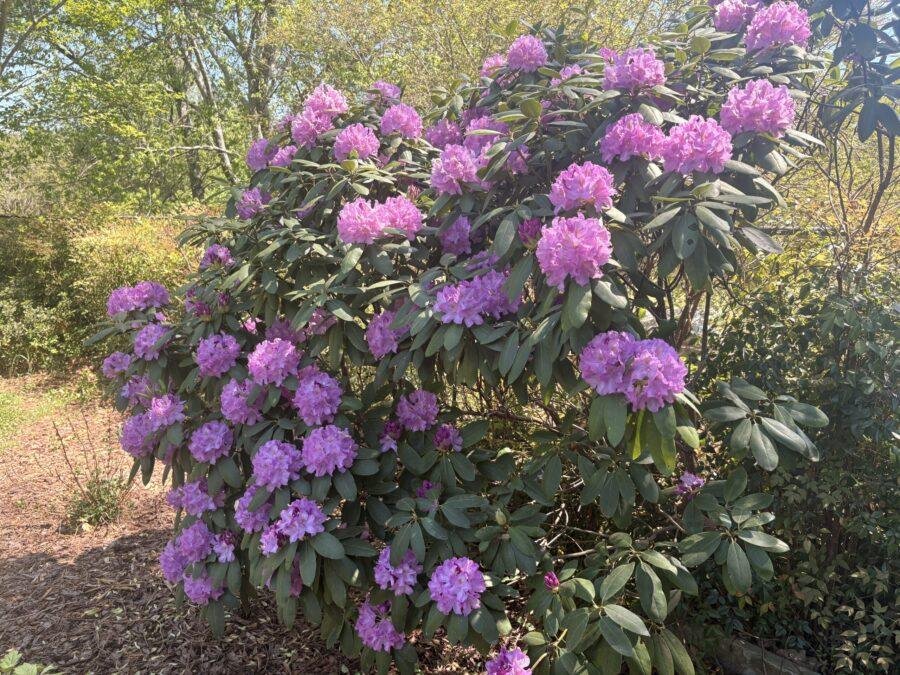
Rhododendrons can provide large clusters of spring flowers along with substantial evergreen foliage.
Depending on the cultivar, flowers may appear in:
- Pink
- Purple
- Red
- White
- Lavender
Rhododendrons usually prefer acidic soil rich in organic matter with dependable moisture and good drainage.
Many appreciate partial shade and protection from intense afternoon sun.
One benefit of this group is the large variety available. Some rhododendrons are suitable for considerably colder climates than gardenias, camellias, or Indian hawthorn.
For example, the PJM group contains compact broadleaf evergreen rhododendrons bred for increased winter hardiness.
5. Japanese Pieris
Japanese pieris gives you more than flowers.
The plant has evergreen leaves, but its new foliage can emerge in shades of bronze or red before turning green.
Then come the flowers.
Clusters of small bell-shaped white or pink flowers hang from the branches in spring, giving the plant a delicate appearance.
Pieris generally prefers:
- Acidic soil
- Good drainage
- Organic matter
- Partial shade
- Protection from harsh afternoon sun in hot climates
There are full-sized and dwarf cultivars, which makes pieris useful in both larger beds and smaller foundation plantings.
NC State Extension describes Japanese pieris as a broadleaf evergreen shrub that prefers moist, well-drained acidic soil and often benefits from shade in Southern gardens.
6. Mountain Laurel
Mountain laurel is a beautiful broadleaf evergreen native to eastern North America.
Its spring flowers are particularly interesting. Individual blooms have a distinctive cup-like shape and may be white, pink, rose, or patterned with darker markings.
Mountain laurel works naturally in:
- Woodland gardens
- Partially shaded borders
- Naturalized areas
- Native plant landscapes
It prefers acidic, well-drained soil and is generally happier where it has protection from the harshest afternoon conditions.
Mountain laurel can be a particularly attractive choice for gardeners looking for evergreen flowering shrubs with a native option. NC State Extension identifies it as a broadleaf evergreen with showy spring to early-summer flowers.
7. Loropetalum
Loropetalum has become a landscape favorite in warmer regions, and it’s easy to see why.
Many popular varieties have burgundy or purple foliage along with bright pink fringe-like flowers in spring. Other types have green foliage and white flowers.
There are now loropetalums in dramatically different sizes.
Some remain compact enough for foundation beds while older or larger cultivars can eventually become substantial shrubs.
That’s one reason checking the mature dimensions on the specific cultivar is so important.
Loropetalum usually produces its best flowering and foliage color with plenty of light, although afternoon protection can help in very hot locations.
In colder portions of its range, loropetalum may behave more like a semi-evergreen and can suffer winter damage.
8. Indian Hawthorn
Indian hawthorn is a compact evergreen shrub commonly used in warmer landscapes.
Clusters of white to pink flowers appear in spring against leathery green foliage.
Its naturally rounded habit makes it useful around:
- Foundations
- Walkways
- Borders
- Small landscape beds
Indian hawthorn generally flowers best with good sunlight and well-drained soil.
One thing worth watching is leaf spot. Good air movement, proper spacing, and avoiding unnecessarily wet foliage can help reduce disease pressure.
NC State Extension classifies Indian hawthorn as a broadleaf evergreen shrub and notes that it generally performs best in warmer hardiness zones.
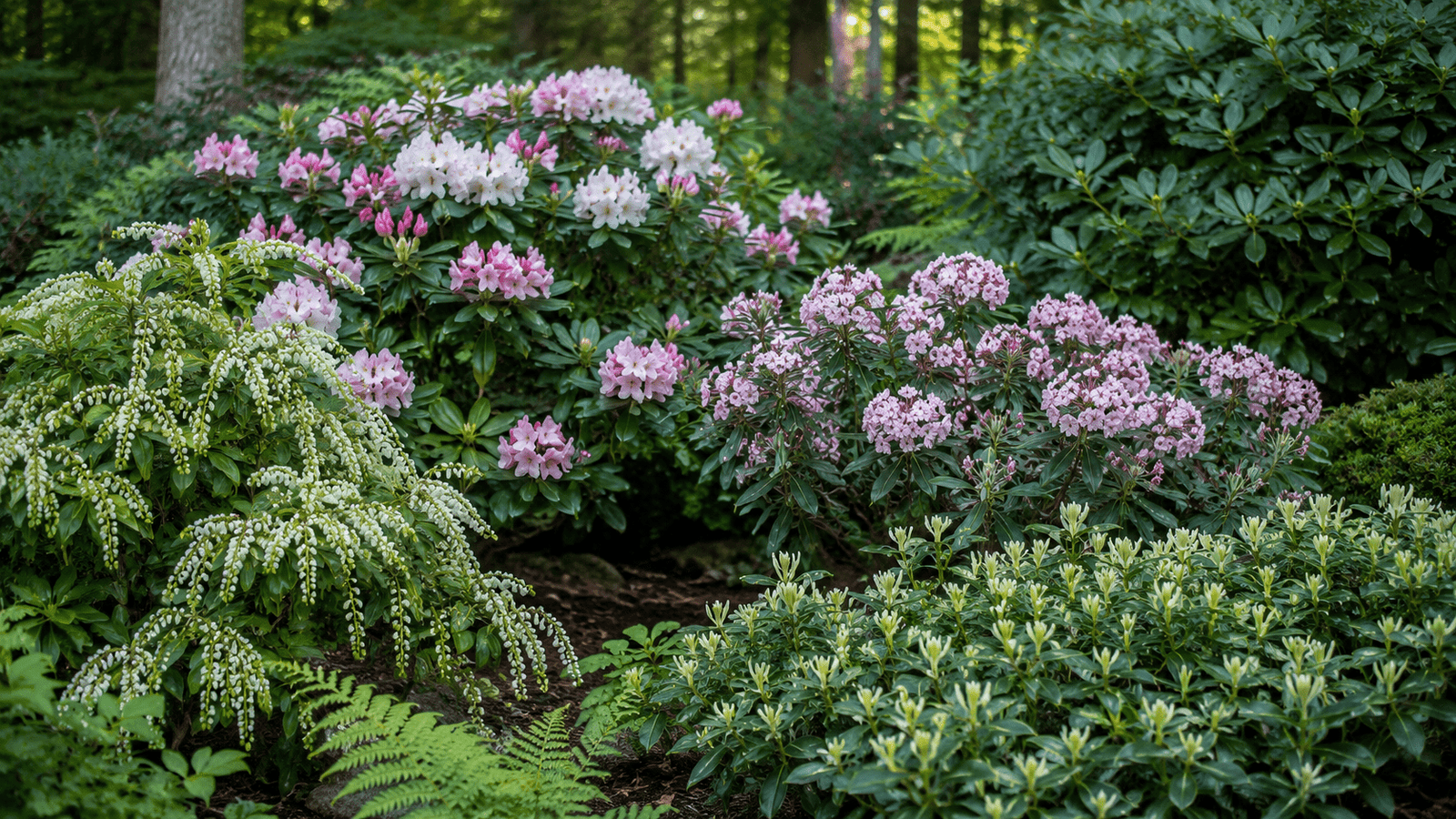
Evergreen Flowering Shrubs for Full Sun
Not all evergreens want shade.
Several evergreen flowering shrubs can handle plenty of sunlight when planted in the appropriate climate.
Good candidates include:
Loropetalum – Plenty of light often produces stronger foliage color and flowering.
Indian hawthorn – Generally flowers best with strong sunlight.
Gardenia – Many cultivars perform well with substantial sunlight as long as soil moisture is managed properly.
Certain camellias – Some sasanqua camellias tolerate more sun than gardeners may expect, especially once established.
Mexican orange – Performs in full sun to partial shade in suitable climates.
If you’re dealing with a particularly bright or hot location, our Best Flowering Shrubs for Full Sun Landscapes goes deeper into choosing plants for those conditions. Best Flowering Shrubs for Full Sun Landscapes
9. Winter Daphne
Winter daphne is grown as much for its fragrance as its appearance.
Clusters of pinkish, lavender, or white flowers can appear during winter or very early spring.
That timing makes daphne especially valuable because there may be very little else flowering in the landscape.
It forms a relatively compact evergreen shrub and works beautifully near an entrance or walkway where the fragrance can be appreciated.
There is a catch.
Daphne can be particular about drainage. It doesn’t appreciate soggy soil, and disturbing an established plant isn’t always a good idea.
This is a shrub where finding the right location from the beginning can make a big difference.
NC State Extension describes winter daphne as a broadleaf evergreen with strongly fragrant winter flowers.
10. Mexican Orange
Mexican orange, or Choisya, isn’t as familiar to many American gardeners as azalea or gardenia, but it’s an interesting choice where winters are mild enough.
It produces fragrant white flowers along with aromatic evergreen foliage.
Plants can be used as:
- Specimens
- Hedges
- Foundation shrubs
- Mixed borders
- Privacy plantings
It grows in sun or partial shade but appreciates some protection from extreme conditions.
Flowers usually appear heavily in spring, and additional flowering may occur later.
Because Mexican orange isn’t suited to every climate, check your hardiness zone before purchasing it.
NC State Extension lists Mexican orange as a broadleaf evergreen suited primarily to milder winter areas.
11. Coastal Leucothoe
Coastal leucothoe, also called coastal doghobble, is an interesting option for a more natural or woodland-style landscape.
This evergreen shrub is native to the Southeast and produces clusters of small white flowers in spring.
The foliage adds interest too. Leaves may develop bronze or purple tones during colder weather.
It generally prefers:
- Partial shade
- Acidic soil
- Organic matter
- Consistent moisture
- Protection from drought
Coastal leucothoe can work particularly well along woodland edges or in naturalized landscapes where the soil doesn’t become excessively dry.
NC State Extension identifies coastal leucothoe as an evergreen Southeastern native with spring flowers and good tolerance for shade.
Small Evergreen Flowering Shrubs
You don’t need a huge yard to use evergreen flowering shrubs.
Many newer cultivars have been selected specifically for smaller landscapes.
Good possibilities include compact forms of:
- Gardenia
- Azalea
- Camellia
- Loropetalum
- Japanese pieris
- Rhododendron
This is one place where reading the plant tag carefully matters.
Two plants with the same common name can have dramatically different mature sizes.
A loropetalum that matures around three feet tall is a completely different landscape plant from one capable of growing well above six feet.
Never choose spacing based on the size of the shrub in the nursery pot.
Look at its expected mature height and width.
Our How to Plant Flowering Shrubs for the Best Results guide explains how mature size, sunlight, drainage, and spacing should influence planting decisions. How to Plant Flowering Shrubs for the Best Results
Evergreen Flowering Shrubs for Shade
Part shade opens up some excellent choices.
Among the best evergreen flowering shrubs for protected or partially shaded locations are:
- Camellia
- Evergreen azalea
- Rhododendron
- Japanese pieris
- Mountain laurel
- Leucothoe
- Winter daphne
But shade is not all the same.
Bright morning sun followed by afternoon shade can be completely different from dense shade beneath several large trees.
A flowering shrub planted in very deep shade may stay alive but produce fewer flowers.
Before buying, watch the planting area throughout the day and see when direct sunlight actually reaches it.
How to Choose Evergreen Flowering Shrubs
Don’t choose the plant based only on the flowers.
Before adding evergreen flowering shrubs to your landscape, check these factors.
Your hardiness zone
This is especially important with gardenias, Indian hawthorn, camellias, and other plants that may be damaged by severe winter temperatures.
Some shrubs remain evergreen only within certain portions of their growing range.
Sunlight
Watch the bed throughout the day.
Morning sunlight is generally gentler than strong late-afternoon sun reflecting from a brick wall, driveway, or sidewalk.
Drainage
Evergreen doesn’t mean wet-soil tolerant.
Plants such as daphne can be especially unhappy in poorly drained locations.
Mature size
Give the shrub room to become what it is supposed to become.
Constantly cutting a large-growing shrub down to fit a tiny foundation bed creates unnecessary maintenance.
Soil pH
Camellias, azaleas, rhododendrons, pieris, mountain laurel, and several other shrubs on this list generally prefer acidic growing conditions.
If you’re unsure about your soil, a soil test is much more useful than guessing.
UGA Extension’s Landscape Plants for Georgia reference includes mature size, exposure, growth habit, and evergreen classifications for many common landscape shrubs. UGA Extension Landscape Plants for Georgia
Maintenance
Low maintenance doesn’t mean no maintenance.
Most shrubs still need proper planting, watering during establishment, mulch, occasional pruning, and attention to pests or disease.
If easier care is a priority, also see our Best Low-Maintenance Shrubs for Your Front Yard. Best Low-Maintenance Shrubs for Your Front Yard
Do Evergreen Flowering Shrubs Stay Green All Winter?
Usually, but there are exceptions.
The word evergreen means a plant retains functional foliage rather than dropping all of its leaves at once every fall.
It does not mean every leaf stays on the plant forever.
Evergreens regularly replace older leaves.
Extreme cold can also cause:
- Leaf discoloration
- Winter burn
- Partial leaf drop
- Stem damage
And shrubs growing near the cold edge of their hardiness range may lose considerably more foliage than the same variety growing farther south.
Loropetalum is a good example. It may remain fully evergreen through a mild Southern winter but behave more like a semi-evergreen after significant cold.
Are Evergreen Flowering Shrubs Low Maintenance?
Some can be.
Once established in the correct location, many evergreen shrubs need only moderate maintenance.
The biggest mistakes usually happen before the plant ever has a chance to settle in:
- Planting a shade-loving shrub in hot afternoon sun
- Planting too deeply
- Choosing poorly drained soil
- Placing a large-growing variety in a tiny bed
- Allowing a newly planted shrub to dry out
- Pruning at the wrong time
Choosing the right plant for the location does more to reduce future maintenance than almost anything else.
Frequently Asked Questions About Evergreen Flowering Shrubs
What evergreen shrub has the prettiest flowers?
That depends on what you like, but camellias, azaleas, rhododendrons, and gardenias are hard to beat for showy flowers.
Gardenias add strong fragrance, while camellias have the added advantage of flowering when many other shrubs are finished.
What evergreen flowering shrub blooms the longest?
Bloom length varies tremendously by cultivar and climate.
Some gardenias rebloom, while certain azaleas have been bred to produce more than one flowering period. Loropetalum may also produce scattered flowers after its primary spring bloom.
Rather than choosing solely by advertised bloom length, look for a plant well adapted to your conditions. A healthy shrub usually puts on a better display than a poorly placed “long-blooming” variety.
Which evergreen flowering shrubs are best for full sun?
Loropetalum, Indian hawthorn, certain gardenias, some camellias, and Mexican orange can all be possibilities for sunny locations, depending on climate and cultivar.
Which evergreen flowering shrubs are best for shade?
Camellias, evergreen azaleas, rhododendrons, Japanese pieris, mountain laurel, leucothoe, and winter daphne are worth considering for partial shade.
Most still need some usable light for their best flowering.
Are all azaleas evergreen?
No.
Many commonly sold landscape azaleas are evergreen or semi-evergreen, but native North American azaleas are generally deciduous.
Check the specific plant rather than assuming all azaleas behave the same way.
Are evergreen flowering shrubs good for foundation plantings?
Absolutely, provided you choose the correct mature size.
Compact gardenias, azaleas, loropetalums, pieris, and other smaller cultivars can work beautifully around a home.
Avoid planting a shrub capable of growing eight feet tall beneath a three-foot window and expecting pruning to solve the problem forever.
Final Thoughts
Evergreen flowering shrubs can make a landscape feel finished throughout the entire year.
The foliage provides structure during winter, while flowers bring seasonal color back into the garden. Camellias, gardenias, azaleas, rhododendrons, pieris, mountain laurel, loropetalum, Indian hawthorn, daphne, Mexican orange, and leucothoe give gardeners a wide range of options.
You don’t need all 11.
Choose the few that actually fit your sunlight, climate, soil, and available space.
A shrub that naturally likes the conditions in your yard will almost always be easier to care for than one you’re constantly trying to convince to grow somewhere it doesn’t belong.
Discover more from Bobby and Lynn’s Plant Farm
Subscribe to get the latest posts sent to your email.