If you are wondering how to prune panicle hydrangeas, the good news is that they are among the easiest hydrangeas to prune. Panicle hydrangeas bloom on new wood, which means their flower buds form on the fresh growth produced during the current season.
That gives you a little more room for error than with hydrangeas that bloom on old wood.
Popular panicle hydrangeas include:
- Limelight
- Little Lime
- Phantom
- Pink Diamond
- Quick Fire
- Bobo
- Vanilla Strawberry
If you have one of these, this guide will show you how to prune panicle hydrangeas step by step without making the job more complicated than it needs to be.
Quick Answer: How to Prune Panicle Hydrangeas
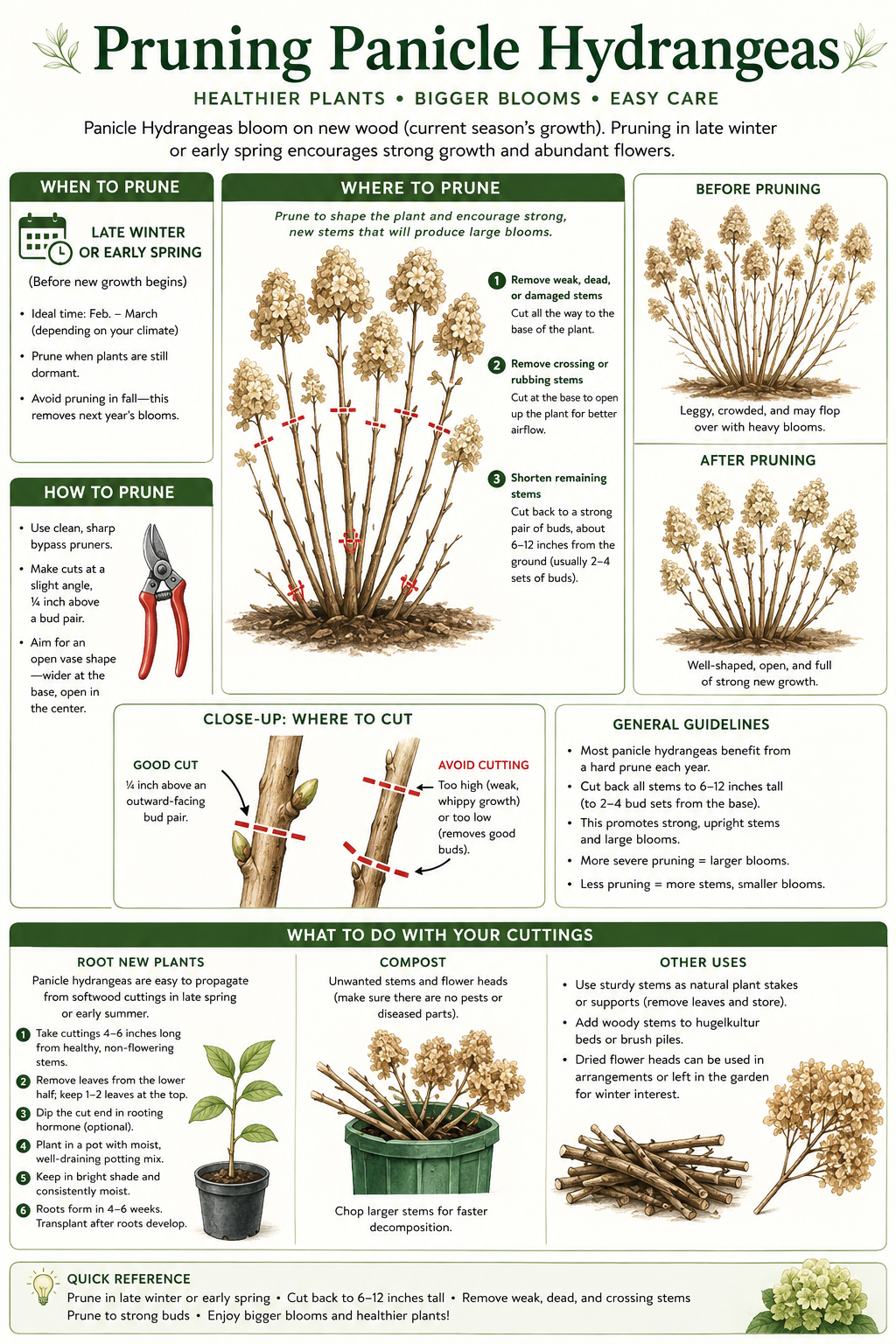
The best time to prune panicle hydrangeas is usually late winter or early spring, before strong new growth begins.
Start by removing dead, broken, weak, or crossing branches. Then thin out small twiggy growth and shorten the remaining healthy stems to improve the shape of the plant.
Many established panicle hydrangeas can be reduced by roughly one-third during annual pruning, but how much you remove depends on the variety, age, and size of the shrub.
Because panicle hydrangeas bloom on new wood, pruning at this time will not remove the flower buds they need for summer blooms.
About Bobby & Lynn

Why It Matters How to Prune Panicle Hydrangeas in Late Winter
Panicle hydrangeas produce flowers on stems that grow during the current season.
That is what gardeners mean when we say they bloom on new wood.
This is important because hydrangeas that bloom on old wood may already have flower buds sitting on their stems before spring arrives. Pruning those plants at the wrong time can remove the blooms before they ever open.
Panicle hydrangeas are different.
According to NC State Extension’s guide to panicle hydrangeas, Hydrangea paniculata can be pruned heavily in late winter or spring because it flowers on the current season’s growth.

When Should You Prune Panicle Hydrangeas?
For most gardeners, late winter through early spring is the easiest time.
Here in Georgia, that often means sometime from late February into early March, depending on the weather.
Gardeners farther north may need to wait longer.
The important thing is not the exact date on the calendar. You are looking for the period after the worst winter weather has passed but before the shrub has put on a lot of new spring growth.
You can also prune panicle hydrangeas after they become dormant in late fall, but we generally prefer late winter or early spring.
With the leaves gone, you can see the plant’s structure clearly and decide which branches actually need to stay.
Panicle hydrangeas usually need only light to moderate pruning. Start by removing dead, damaged, weak, or crossing stems. Then shorten overly long branches to a healthy set of buds to improve the shape.
You do not need to cut a panicle hydrangea back hard each year to get good blooms. A lighter approach helps the plant keep a strong framework while still producing plenty of new flowering growth.
Before You Learn How to Prune Panicle Hydrangeas, Identify the Plant
This is probably the most important step.
Do not start pruning until you know which type of hydrangea you have.
Panicle hydrangeas usually produce cone-shaped flower clusters. The flowers often begin white or pale green and may turn pink, rose, or reddish as they age.
Bigleaf hydrangeas commonly produce rounded flower heads in blue, pink, or purple and may require completely different pruning.
If you are unsure which type you have, visit our Hydrangea Care guide before making any major cuts.
Tools You Need for Pruning Panicle Hydrangeas
You do not need a shed full of equipment.
For most panicle hydrangeas, three basic tools are plenty.
Bypass Pruners
Use bypass pruners for smaller stems and everyday pruning cuts.
A sharp pair makes a cleaner cut and is much easier on both the plant and your hands.
You can see the bypass pruners we recommend.
Loppers
Once the stems become too thick for hand pruners, switch to loppers.
The longer handles give you more leverage and make it much easier to remove older woody stems.
You can see the loppers we recommend.
Garden Gloves
A good pair of gloves helps protect your hands when you are reaching through a mature shrub.
You can see the garden gloves we recommend.
When learning how to prune panicle hydrangeas, the right tools make the job easier and help you make cleaner cuts
Affiliate Disclosure: As an Amazon Associate, Bobby & Lynn’s Plant Farm may earn from qualifying purchases at no extra cost to you.
Step 1: Stand Back and Look at the Whole Plant
Before making the first cut, take a few seconds to look at the entire shrub.
This may sound simple, but it helps keep you from cutting too much too quickly.
Look for:
- Dead branches
- Broken stems
- Crossing branches
- Weak growth
- Thin twiggy stems
- Branches growing toward the center
- Stems sticking far outside the natural shape
Your goal is not to give the hydrangea a haircut.
You are trying to build a strong framework that can support healthy new growth and flowers.
Step 2: Remove Dead, Broken, or Damaged Branches
Start with the obvious cuts.
Remove branches that are dead, cracked, damaged, or broken.
If you are unsure whether a branch is alive, lightly scratch the bark.
Green tissue underneath usually means the stem is still alive.
Brown and dry tissue may mean that section is dead.
Cut dead stems back to healthy wood or remove them completely at the base if necessary.
Once the damaged growth is gone, the shape of the plant will be much easier to see.
Step 3: Remove Thin and Weak Growth
Next, look for small, weak, twiggy stems.
Panicle hydrangeas can produce heavy flower heads. Very thin stems may struggle to support those blooms and can flop toward the ground.
Removing some of that weak growth allows the shrub to put more energy into stronger branches.
It also opens the middle of the plant and improves airflow.
You do not need to remove every small stem.
The goal is to reduce congestion, not strip the plant bare.
Step 4: Remove Crossing and Inward-Growing Branches
Look for stems rubbing against one another or growing directly toward the center of the shrub.
Remove the weaker or less useful branch.
Branches constantly rubbing together can damage the bark, while too much inward growth can make the middle of the plant crowded.
A more open framework usually produces a stronger, better-shaped shrub.
Step 5: Decide How Far Back to Prune
Now you can begin shortening the healthy stems.
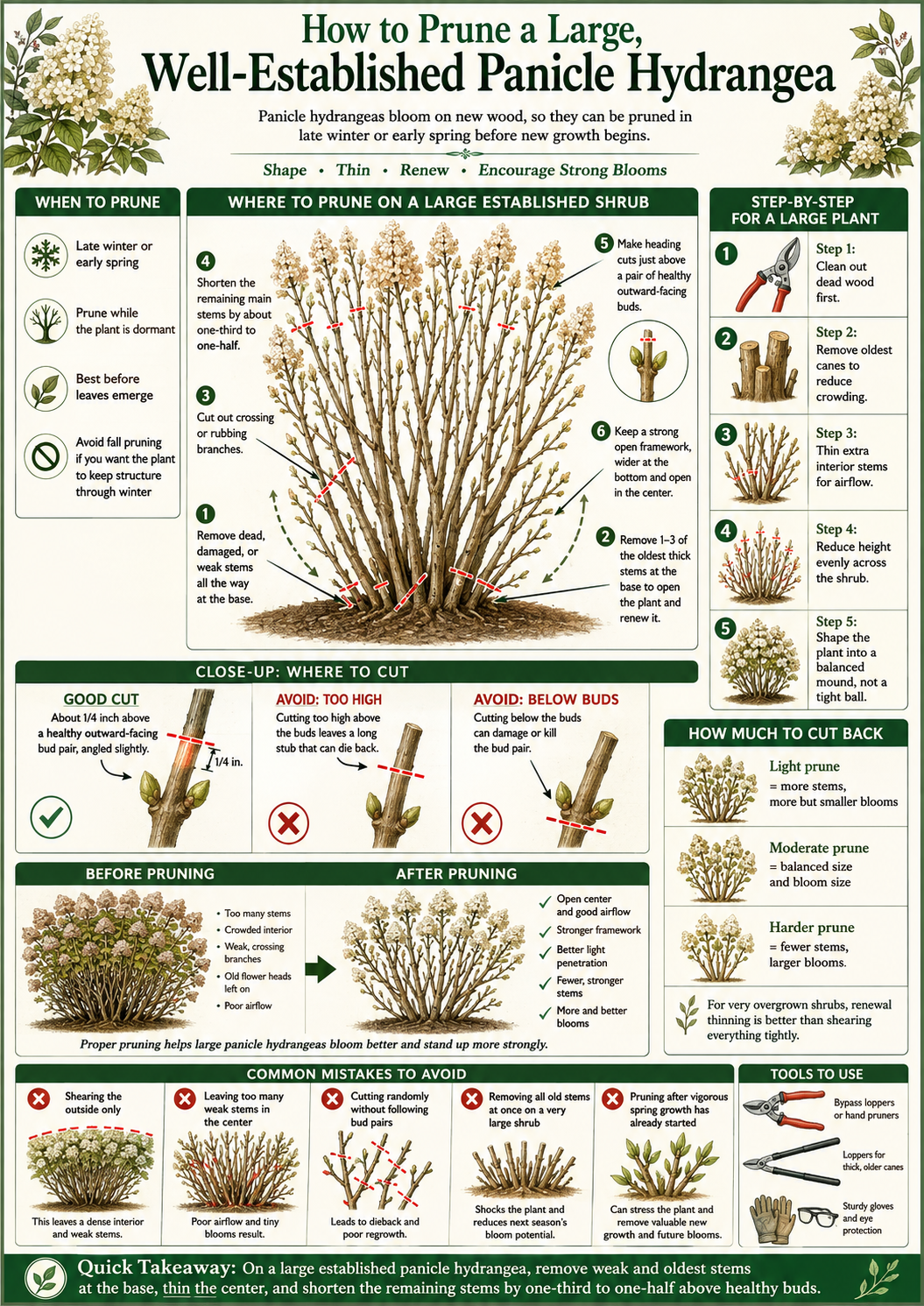
Many established panicle hydrangeas can be reduced by around one-third during normal annual pruning.
That does not mean every panicle hydrangea should be cut back exactly one-third.
A mature Limelight may need much more shaping than a compact Bobo.
Consider:
- The mature size of the variety
- How large the shrub has become
- How strong the existing stems are
- Whether the plant is overgrown
- The shape you want to maintain
For light pruning, simply shorten overly long stems and clean up the overall shape. One of the biggest questions people have when learning how to prune panicle hydrangeas is how far back they should cut.
For an older or overgrown shrub, you can prune more aggressively.
Step 6: Make Cuts Above Healthy Buds
When shortening a branch, make your cut just above a healthy pair of buds when possible.
Those buds will produce new shoots once spring growth begins.
Try not to leave long bare stubs above the buds.
Clean cuts heal better and leave the plant looking neater.
Step 7: Keep a Strong Framework
One mistake we see is cutting every branch back to the exact same height.
That can leave the hydrangea looking unnatural and may not give the shrub the strongest structure.
Instead, keep several healthy main stems and work with the plant’s natural shape.
You want a balanced, rounded framework rather than a flat top.
Step back every few cuts and look at the whole shrub again.
That little habit can keep you from going too far.
Step 8: Remove Last Year’s Flower Heads
If dried flower heads are still hanging on the shrub, you can remove them while you prune.
Cut them off just above a healthy pair of buds.
This is also a good time to remove stems that were bent or damaged by the weight of old blooms.

Should You Cut Panicle Hydrangeas to the Ground?
Usually, no.
Panicle hydrangeas can tolerate hard pruning, but cutting an established plant completely to the ground every year is generally unnecessary.
Keeping a strong woody framework gives the shrub structure and helps support the large flowers it produces later in the season.
Hard pruning may be useful when rejuvenating an old, neglected, or badly shaped shrub, but it should not automatically be your yearly routine.
For a visual example, take a look at our Panicle Hydrangea Pruning Guide.
We also have a separate guide for pruning well-established panicle hydrangeas if you are working with a larger mature shrub.
How Hard Pruning Affects Panicle Hydrangeas
There can be a tradeoff with hard pruning.
A harder pruning can produce fewer but stronger shoots, and those shoots may carry larger flower clusters.
Lighter pruning leaves more stems, which can result in more flowering points but sometimes smaller individual blooms.
That is one reason there is no perfect pruning height for every panicle hydrangea.
The best approach depends on the plant and what you are trying to accomplish.
Common Mistakes When Learning How to Prune Panicle Hydrangeas
Pruning the Wrong Type of Hydrangea
This is the big one.
Do not assume every hydrangea should be pruned like a panicle hydrangea.
Always identify the plant first.
Pruning Too Late
Once the plant has put on a lot of fresh spring growth, a heavy pruning removes growth the shrub has already spent energy producing.
Late winter or early spring is generally easier.
Leaving Too Much Weak Growth
Keeping every small stem can result in a crowded shrub and weaker branches supporting heavy blooms.
Thin selectively.
Cutting Every Stem to the Same Height
This can leave the plant looking like it has been sheared rather than selectively pruned.
Work with the shrub’s natural shape.
Removing Too Much Strong Old Wood
Old does not automatically mean bad.
Healthy mature stems provide structure.
Remove what needs to go, but do not feel like you have to replace the entire plant every spring.
What to Do After You Prune Panicle Hydrangeas
Once you finish, remove the cut branches and old flower heads from around the base.
If needed, add a fresh layer of mulch to help conserve moisture and reduce weeds.
Keep mulch a few inches away from the main stems rather than piling it against the base of the plant.
There is no need to force new growth.
As temperatures warm naturally, the shrub will begin waking up.
Once active growth starts, keep an eye on soil moisture, especially during dry spring weather.
A Simple Rule for How to Prune Panicle Hydrangeas
If you remember only one thing, remember this:
Panicle hydrangeas bloom on new wood, so late winter or early spring is the time to remove dead and weak growth, thin crowded stems, and shape the shrub before strong spring growth begins.
Do not worry about making every cut perfect.
Panicle hydrangeas are forgiving plants.
Start with the obvious problems, keep a strong framework, and shape the shrub a little at a time.
Get a Reminder When It Is Time to Prune
Pruning time can sneak up on you, especially when different plants need attention at different times of the year.
Our free Garden Help by Bobby & Lynn app includes seasonal plant-care reminders.
You can turn on push notifications for pruning, watering, fertilizing, extreme heat, and other timely garden jobs.
Visit our Garden Help app and save it to your phone.
When panicle hydrangea pruning season rolls around, we plan to send a reminder so you do not have to keep the timing stored in your head all winter.
Final Tips From the Plant Farm
The easiest way to learn how to prune panicle hydrangeas is to start slowly.
Remove dead and damaged wood first.
Then remove weak growth.
After that, shape what remains.
There are several perfectly good ways to prune a panicle hydrangea, and every shrub is a little different.
This is the method that has worked well for us at Bobby & Lynn’s Plant Farm, and it keeps the goal simple: build a healthy framework, encourage strong new growth, and give those summer blooms the support they need.