
If you are wondering how to prune Rose of Sharon, the good news is that this flowering shrub is fairly forgiving. Rose of Sharon blooms on new wood, which means its flowers develop on the fresh growth it produces during the current season.
That makes late winter or early spring the best time for most of the major pruning.
Here in Georgia, we usually look at pruning Rose of Sharon sometime in late winter before strong spring growth gets underway. Gardeners in colder areas may need to wait a little longer.
Quick Answer: How to Prune Rose of Sharon
The best time to prune Rose of Sharon is in late winter or early spring before new growth begins.
Start by removing dead, damaged, weak, or crossing branches. Then thin crowded growth and shorten overly long stems to improve the shrub’s shape.
For routine maintenance, you do not need to cut the entire plant down. Selective pruning usually produces a healthier, more natural-looking shrub.
Because Rose of Sharon blooms on new wood, late-winter pruning will not remove the flower buds needed for that summer’s blooms.
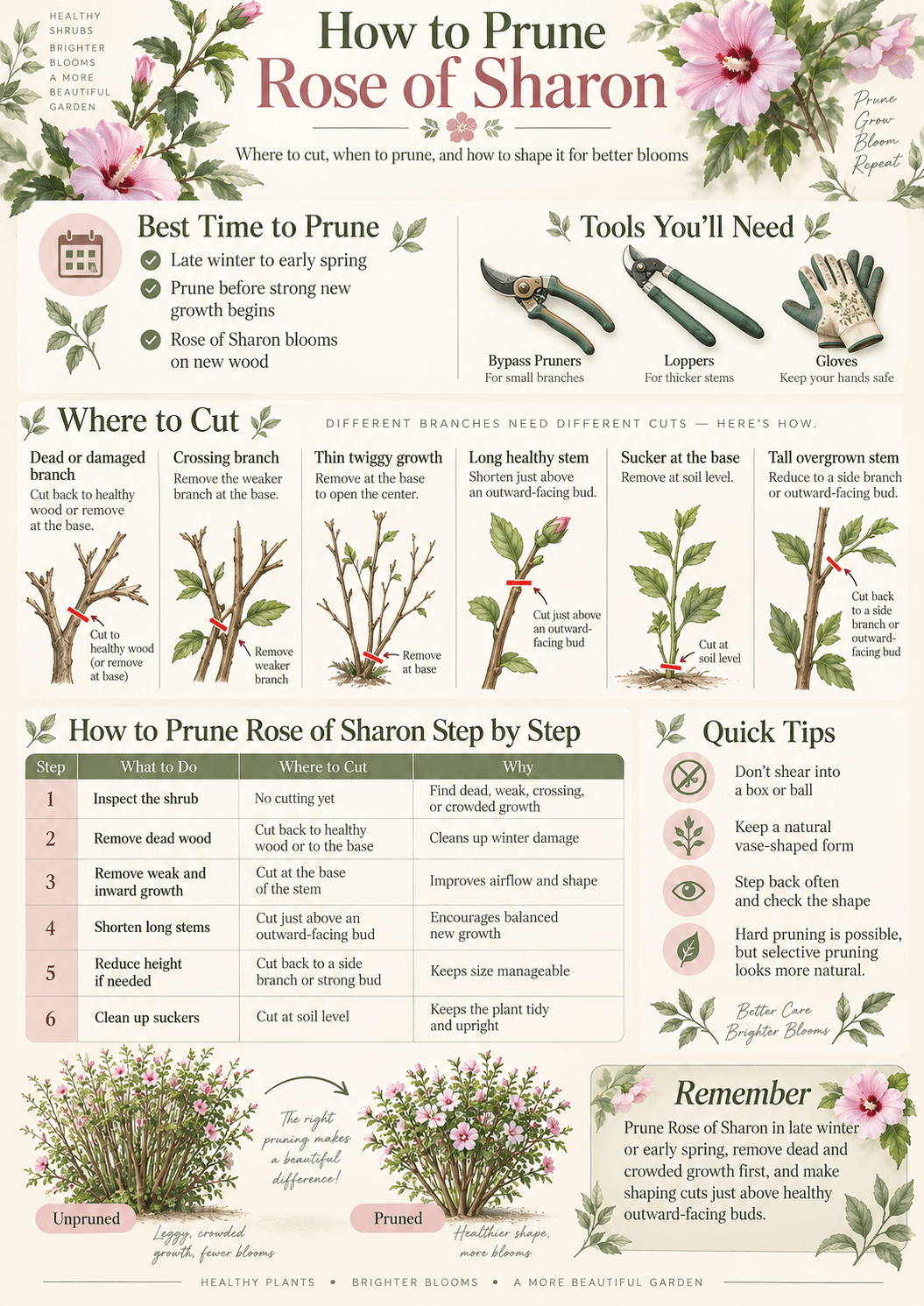
Why Knowing How to Prune Rose of Sharon Matters
Rose of Sharon can become a fairly large shrub if it is allowed to grow without pruning.
Depending on the variety, an established plant may reach 8 feet tall or more. Over time, it can become woody, crowded, or taller than you want for the space.
Pruning can help:
- Control the height and width
- Remove dead or damaged branches
- Improve the overall shape
- Open crowded growth
- Encourage strong new stems
- Improve airflow through the shrub
- Keep an older plant from becoming too leggy
Rose of Sharon produces flowers on the current season’s growth. Clemson Extension recommends pruning before spring growth begins and specifically notes that late winter is an appropriate time for Rose of Sharon. You can read more in Clemson’s Rose of Sharon growing guide.
When to Prune Rose of Sharon
Timing is one of the most important parts of learning how to prune Rose of Sharon.
For most gardeners, late winter through early spring is the easiest pruning window.
You want to prune after the worst winter weather has passed but before the shrub has produced a lot of fresh spring growth.
Here in north Georgia, that will often mean sometime around late February into early March, depending on the weather.
Farther north, that window may occur several weeks later.
Do not worry about hitting one exact date.
Watch the plant and your local weather.
Can You Prune Rose of Sharon in Fall?
You can remove broken or damaged branches whenever necessary, but we generally prefer to save major pruning for late winter or early spring.
Heavy pruning in fall can encourage new growth at a time when the plant should be preparing for winter.
Waiting until late winter also makes it easier to see the framework of the shrub once the leaves are gone.
Tools for How to Prune Rose of Sharon
You do not need many tools to prune Rose of Sharon.
For most shrubs, a pair of hand pruners and loppers will handle nearly everything.
Bypass Pruners
Use bypass pruners for smaller branches and everyday shaping cuts.
Sharp bypass pruners make clean cuts without crushing the stems.
You can see the bypass pruners we recommend.
Loppers
Older Rose of Sharon shrubs can develop some fairly thick woody stems.
When a branch becomes too large to comfortably cut with hand pruners, use loppers instead.
You can see the loppers we recommend.
Garden Gloves
Gloves are useful when reaching into the center of a large shrub and cleaning up cut branches afterward.
You can see the garden gloves we recommend.
Affiliate Disclosure: As an Amazon Associate, Bobby & Lynn’s Plant Farm may earn from qualifying purchases at no extra cost to you.
Step 1: Inspect the Plant Before You Prune Rose of Sharon
Do not start cutting as soon as you walk up to the shrub.
Stand back for a minute and look at the whole plant.
Look for:
- Dead branches
- Broken stems
- Crossing branches
- Weak growth
- Branches growing toward the center
- Suckers around the base
- Branches growing far outside the natural shape
Decide what you want the shrub to look like before you start.
It is much easier to take another branch off later than it is to put one back.
Step 2: Remove Dead and Damaged Branches
When learning how to prune Rose of Sharon, dead and damaged wood should always be the first thing you remove.
Cut away branches that are:
- Dead
- Broken
- Cracked
- Diseased
- Badly damaged
If you are unsure whether a branch is alive, lightly scratch a small area of bark.
Green tissue underneath usually indicates that the branch is alive.
Brown, dry tissue may mean that section is dead.
Work your way down the stem until you find healthy wood.
Step 3: Remove Crossing and Inward-Growing Branches
Next, look for branches rubbing against each other.
When two branches cross, decide which one contributes more to the shape of the shrub and remove the other.
Also remove some stems that are growing directly into the center.
The idea is not to hollow out the shrub.
You simply want enough space between the main branches for light and air to move through the plant.
Step 4: Remove Weak and Twiggy Growth
Rose of Sharon can produce a lot of smaller shoots.
Some are useful.
Others simply crowd the plant.
Remove weak, thin, or poorly positioned stems that are unlikely to contribute much to the shrub’s framework.
This allows the plant to put more energy into stronger branches.
Step 5: How Far Back Should You Prune Rose of Sharon?
One of the biggest questions about how to prune Rose of Sharon is how much you should remove.
There is no single height that works for every shrub.
For routine pruning, you may only need to shorten long stems and remove unwanted growth.
If the shrub has become too large, you can reduce its overall size more aggressively.
A good approach is to shorten selected branches rather than cutting every stem to exactly the same height.
Rose of Sharon naturally has an upright, vase-like growth habit. Working with that natural form usually gives you a better-looking plant than shearing it into a ball or box.
Step 6: Make Cuts Above Healthy Buds
When shortening a healthy branch, make the cut just above a healthy bud or node when possible.
New growth will develop below the cut.
Think about the direction in which you want the new branch to grow.
A bud pointing outward can help encourage growth away from the crowded center of the shrub.
Use clean, sharp pruners so you do not crush or tear the branch.
Step 7: Shape Rose of Sharon Without Giving It a Haircut
This is where it is easy to get carried away.
Rose of Sharon does not need to look perfectly symmetrical.
Natural variation usually looks better.
Step back every few cuts and look at the whole shrub.
Remove stems that stick far outside the overall shape and shorten branches that are making one side noticeably heavier than the other.
Avoid cutting every branch at exactly the same height.
You are pruning a flowering shrub, not trimming a hedge.
How to Prune Rose of Sharon That Has Become Too Tall
An older Rose of Sharon can eventually become much taller than expected.
If yours has outgrown its space, resist the temptation to simply chop the entire top off at one height.
Instead, gradually reduce some of the tallest branches by cutting them back to healthy side branches or buds.
Remove a few of the oldest or poorly positioned stems if necessary.
This produces a more natural-looking shrub and avoids leaving a row of obvious stubs across the top.
If the shrub is extremely overgrown, you may want to reduce its size over more than one season rather than trying to completely rebuild it in one afternoon.
Can You Prune Rose of Sharon Hard?
Yes. Rose of Sharon can tolerate fairly hard pruning.
Because it blooms on new wood, even a significant late-winter pruning can still be followed by flowers later in the season.
However, the fact that a plant can tolerate severe pruning does not mean it needs it every year.
For most healthy shrubs, selective annual pruning is enough.
Hard pruning is more appropriate when the plant has become:
- Severely overgrown
- Very leggy
- Badly shaped
- Damaged
- Neglected for many years
Clemson notes that Rose of Sharon flowers on the current season’s branches, which is why late-winter pruning works well for this shrub.
Does Hard Pruning Rose of Sharon Make Bigger Flowers?
Pruning more heavily can sometimes result in fewer stems carrying larger individual flowers.
Lighter pruning generally leaves more flowering stems and may produce a greater number of somewhat smaller blooms.
That does not mean you need to severely prune your Rose of Sharon just to get good flowers.
For most gardeners, maintaining a healthy plant with a strong framework is more important than trying to produce the biggest possible bloom.
How to Prune Rose of Sharon Suckers
Rose of Sharon may produce shoots from around the base.
If you want the plant to remain a clean, upright shrub, remove unwanted suckers near ground level.
Keep shoots that contribute to the shape you want.
Remove those growing:
- Far away from the main framework
- Into crowded areas
- Against structures
- Into walkways or nearby plants
Do not automatically remove every basal shoot. Some can eventually become useful replacement stems as older branches age.
Should You Prune a Young Rose of Sharon?
Young shrubs usually need much less pruning than mature plants.
For the first few years, concentrate on developing a strong framework.
Remove damaged, weak, or badly positioned branches, but avoid constantly cutting the plant simply because you can.
Young plants need leaves and healthy stems to build a strong root system.
Shape them gradually.
How to Prune Rose of Sharon as a Small Tree
Some gardeners train Rose of Sharon into a small tree form rather than allowing it to grow as a multi-stemmed shrub.
If you want that appearance, choose one strong central trunk.
Gradually remove competing stems from the base and remove lower side branches as the trunk develops.
Do this over time instead of stripping every lower branch from a young plant at once.
Once you establish the desired trunk height, allow the upper branches to form the flowering canopy.
Tree-form Rose of Sharon will usually require a little more maintenance because suckers and new shoots may continue appearing around the base.
Common Mistakes When Learning How to Prune Rose of Sharon
Pruning Too Late
Rose of Sharon is forgiving, but waiting until it has already produced substantial new spring growth means you are cutting off growth the plant has spent energy producing.
Late winter or early spring is easier.
Cutting Every Stem to the Same Height
This often creates an unnatural-looking shrub.
Use selective cuts instead.
Removing Too Much Every Year
Heavy pruning can be useful, but it should not become an automatic yearly routine.
If the plant is healthy and fits its space, lighter pruning may be all it needs.
Ignoring Dead or Crossing Branches
Do not concentrate entirely on reducing height.
Removing damaged, weak, and poorly positioned branches is just as important.
Using Dull Tools
Dull pruners can crush and tear stems.
Keep your pruning tools sharp and clean.
What to Do After You Prune Rose of Sharon
Once you finish pruning, remove the branches and debris from around the shrub.
Take one final look at its shape.
You may notice one or two branches that you missed while standing close to the plant.
There is usually no need to do anything complicated after pruning.
As temperatures warm, the shrub will begin producing fresh growth.
A light layer of mulch can help conserve moisture and reduce weeds, but keep mulch a few inches away from the main stems.
Water as needed once active growth begins, particularly during dry weather.
A Simple Rule for How to Prune Rose of Sharon
If you remember only one thing from this guide, remember this:
Prune Rose of Sharon in late winter or early spring before strong new growth begins.
Remove dead and damaged branches first.
Then thin crowded growth and shape the shrub.
Keep a strong natural framework rather than cutting every branch to the same height.
Rose of Sharon is a forgiving shrub, so there is no need to worry about making every cut perfect.
Get a Reminder When It Is Time to Prune
Remembering when every flowering shrub needs attention can get confusing.
That is one reason we created our free Garden Help by Bobby & Lynn app.
You can turn on push notifications for seasonal pruning reminders along with watering, fertilizing, extreme heat, and other timely plant-care alerts.
There are no ads and no popups, and you can turn notifications on or off whenever you like.
When Rose of Sharon pruning season arrives, a reminder can help you get the job done before spring growth takes off.
Final Tips From the Plant Farm
Learning how to prune Rose of Sharon does not have to be complicated.
Start with dead and damaged wood.
Remove weak and crowded growth.
Then shape what remains.
Take your time and step back occasionally to look at the entire shrub.
There are different ways to prune a plant, and every Rose of Sharon is a little different. This is the approach we use at Bobby & Lynn’s Plant Farm to keep the job simple while encouraging healthy growth and plenty of summer flowers.
Discover more from Bobby and Lynn’s Plant Farm
Subscribe to get the latest posts sent to your email.