Hydrangea care gets a whole lot easier once you know which hydrangea you have. Give it a suitable spot, check the soil before watering, and learn when it is safe to prune. Those simple habits will do more for your plant than chasing every fertilizer or bloom booster on the shelf.
At Bobby & Lynn’s Plant Farm in Dallas, Georgia, we grow hydrangeas through hot summers, unpredictable spring freezes, and soil that does not always cooperate. This guide brings the basics together for gardeners who want to know what to do—and why.
You do not need to become a plant expert before planting your first hydrangea. Start here, then use our detailed guides and free charts whenever you need a closer look.
Disclosure: This post contains affiliate links. As an Amazon Associate, we earn from qualifying purchases.
Quick Answer: What Does a Hydrangea Need?
Most hydrangeas need well-drained soil, enough moisture to keep their roots from drying out, and sunlight suited to their type and climate. Bigleaf hydrangeas generally appreciate morning sun and afternoon shade in the South. Panicle hydrangeas tolerate more sun. Pruning time depends on whether the plant flowers on old wood or new wood.
Fertilizer can support healthy growth, but it cannot replace the right location, water, or healthy flower buds.
For more detailed help, visit our complete Hydrangea Care guide. For visual answers, browse our Hydrangea Guides, Charts & Infographics.

About Bobby & Lynn

Hydrangea Care Starts With Knowing Your Plant
A hydrangea is not just a hydrangea when it comes to pruning and sunlight. Save the nursery tag or photograph it before it disappears into the garden shed.
| Hydrangea type | Identification clues | Practical starting point |
|---|---|---|
| Bigleaf (Hydrangea macrophylla) | Rounded mophead blooms or flat lacecaps; broad leaves | Protect from strong afternoon sun; preserve healthy older stems |
| Panicle (Hydrangea paniculata) | Usually cone-shaped flower clusters | Handles more sun; flowers on current-season growth |
| Smooth (Hydrangea arborescens) | Often rounded white or pink flower clusters | Flowers on current-season growth; avoid letting roots dry out |
| Oakleaf (Hydrangea quercifolia) | Deeply lobed, oak-shaped leaves | Give it good drainage; preserve older stems for flowers |
| Mountain (Hydrangea serrata) | Often delicate lacecap flowers and smaller leaves | Usually appreciates afternoon shade; protect older flowering wood |
Flower shape alone will not identify every variety. Use the tag, leaf shape, and growth habit together.
Reblooming bigleaf and mountain varieties may flower on both old and new wood, but that does not make every haircut harmless.
Our old wood vs. new wood hydrangea guide explains the difference before you make a cut.
Choose Sunlight That Fits Your Hydrangea
Here in Georgia, we recommend morning sun and afternoon shade for bigleaf hydrangeas. A plant tag that says “full sun” needs to be read with your climate in mind. Full sun in a cooler region can be a very different experience from an exposed Georgia yard in July.
NC State Extension’s bigleaf hydrangea profile also recommends protection from afternoon sun. North Carolina Extension Gardener Plant Toolbox
Panicle hydrangeas generally handle more sun. They still need adequate moisture, and relief from the strongest afternoon heat can help in very hot locations.
Before planting, watch the spot at different times of day. Ask:
- Does it get gentle morning light or hot late-afternoon sun?
- Will a nearby tree compete heavily for water?
- Is it beside a wall or pavement that reflects heat?
- Is there enough room for the variety’s mature width?
Don’t judge spacing by the size of the nursery pot. A little shrub can become a whole lot of shrub.
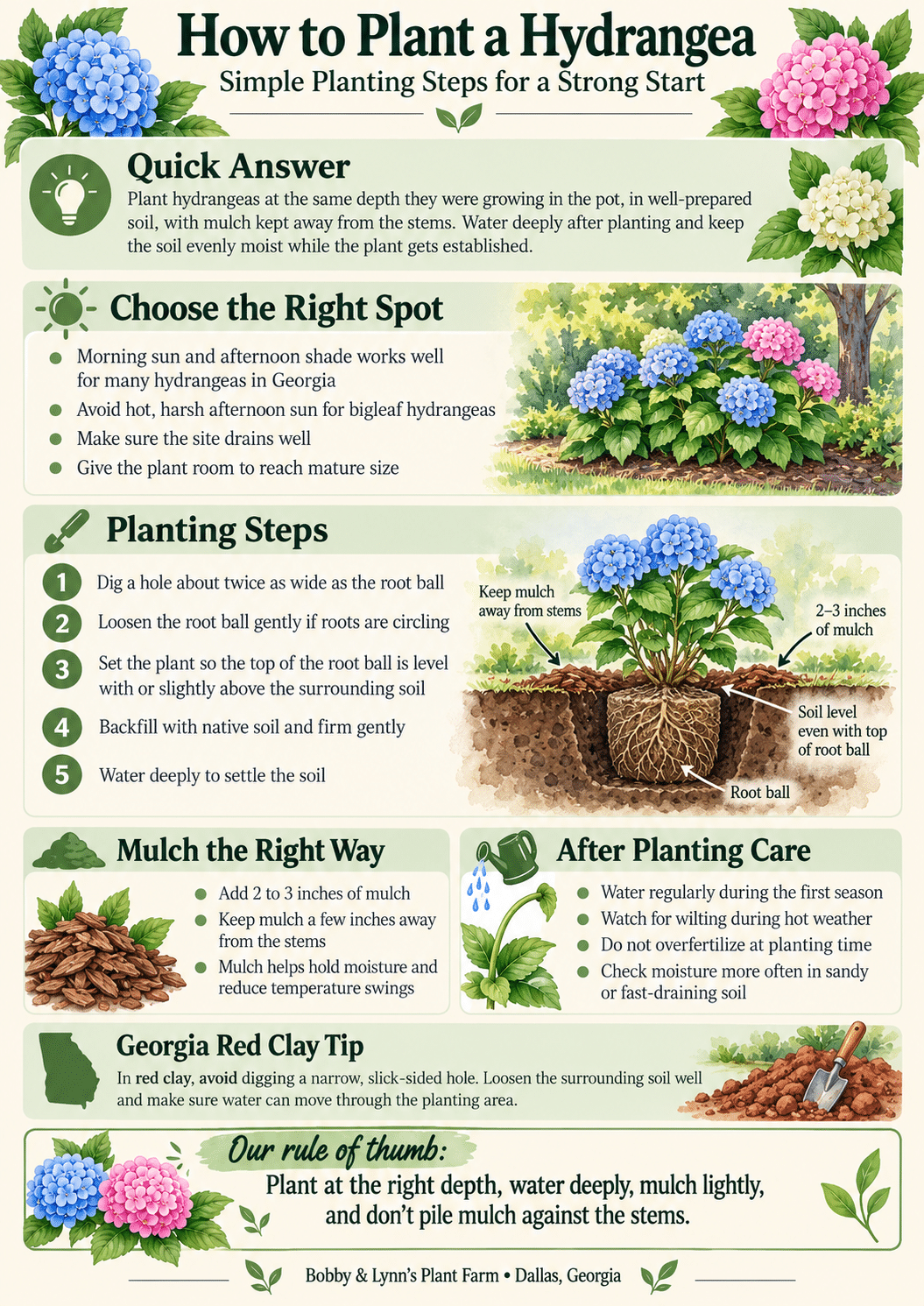
Plant at the Right Depth—and Check Drainage
Spring and fall can both be good planting seasons. In much of the South, fall offers cooler conditions while roots establish. In colder regions, allow time before the ground freezes.
Avoid planting during extreme heat, in frozen ground, or when soil is waterlogged.
Start with these steps:
- Check the root ball. Water the nursery pot before planting if it is dry.
- Dig a wide hole. Make it wider than the root ball, but no deeper than needed to keep its top at the surrounding soil level.
- Inspect the roots. Remove the pot and gently loosen tightly circling roots.
- Check planting depth. Set the plant in place before backfilling.
- Backfill gently. Use mainly the soil you removed and firm it without packing it hard.
- Water thoroughly. Let water soak into the root ball and surrounding soil.
- Add mulch. Spread roughly 2–3 inches over the root area, keeping it several inches away from the stems.
A Hori Hori garden knife is handy for small planting jobs, loosening tightly circling roots, and pulling weeds around your hydrangeas.
In heavy clay, do not make a little pocket of rich potting soil surrounded by poorly draining ground. Improving a broader bed or choosing a better-drained location is more useful.
Where drainage is marginal, planting slightly high may help. A regularly flooded spot needs a different solution.
An inch or two of gravel at the bottom of the hole does not fix drainage.

Hydrangea Care Means Checking Before Watering
There is no watering schedule that fits every hydrangea. Rain, heat, soil, container size, and how recently you planted it all change the answer.
Check the soil a couple of inches down, including the original root ball on a newly planted shrub. The surrounding garden soil can be damp while that root ball is still dry.
If the root area is becoming dry, water slowly at the base so moisture reaches the roots. If it is still wet, adding another soaking can make matters worse.
If you’re still learning when to water, a soil moisture meter can give you another clue. Check several spots around the roots, and compare the reading with how the soil feels rather than relying on the meter alone.
What If the Leaves Wilt in the Afternoon?
A hydrangea may droop temporarily during intense heat even when the soil has moisture. Check again when temperatures cool or early the next morning.
If it recovers and the soil is moist, do not automatically add more water. If it stays wilted, check moisture and drainage promptly.
Persistent wilt in wet soil can indicate a root problem rather than thirst.
New plants deserve closer attention than established shrubs. Container hydrangeas can dry out especially fast and must have drainage holes.
Our Hydrangea Guides & Charts include a watering guide you can save to your phone.
Feed for Healthy Growth, Not a Miracle
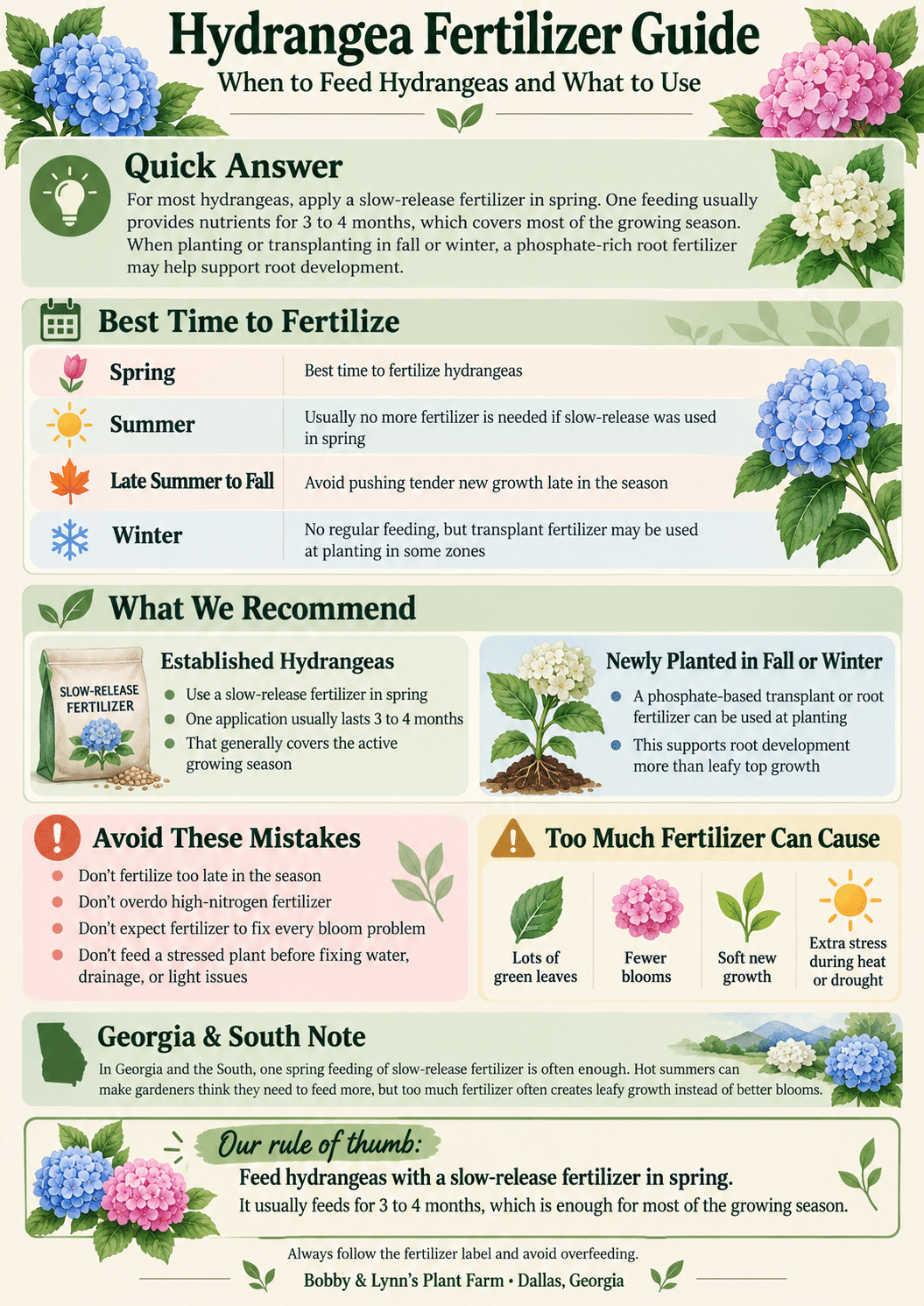
At our plant farm, we favor a suitable slow-release fertilizer in spring when feeding is needed. Some products are labeled to feed for about three to four months, making them a convenient fit for a spring feeding routine.
Check the actual label. Release time changes with the formulation and conditions, and hydrangeas may continue growing well beyond that window.
Applying more fertilizer every time a bloom looks disappointing is not the answer.
A soil test helps determine whether nutrients or pH need attention. Avoid feeding a drought-stressed plant, follow the rate for your product and plant size, and keep fertilizer away from direct contact with stems.
Do not routinely add phosphorus at planting just because it is sold as a root or bloom booster. Add it when a soil test or local Extension recommendation shows a need.
Extra phosphorus will not repair freeze-damaged buds or undo incorrect pruning.

Learn the Pruning Rule Before Picking Up the Pruners
This is where a healthy hydrangea can lose its flowers before spring even arrives.
Old wood means stems grown in previous seasons. New wood means growth produced during the current season.
| Hydrangea type | When to prune if needed |
|---|---|
| Traditional bigleaf and mountain | Lightly after flowering, before next season’s buds develop; avoid routine fall or winter cutting |
| Oakleaf | After flowering; usually needs little pruning |
| Panicle | Late winter or early spring before new growth begins |
| Smooth | Late winter or early spring before new growth begins |
| Reblooming bigleaf and mountain | Preserve healthy older stems to protect early flowers; follow the variety’s guidance |
UGA Extension explains how identifying your hydrangea determines the appropriate pruning season. Read its hydrangea identification and pruning guidance here. UGA Extension Forsyth County
You do not have to prune a hydrangea simply because another year has passed. Start with broken branches and confirmed dead wood, then consider whether shaping is actually needed.
On bigleaf hydrangeas, wait for growth to reveal which stems survived winter. Bare stems can look dead while carrying living buds.
Read our simple pruning guide for every hydrangea type before a major trim.
For small stems and careful cuts, Corona bypass pruners are a practical option. Correct timing matters more than the tool you choose.
A Green Shrub With No Flowers Needs a Checkup
If your hydrangea has leaves but no blooms, review these questions before buying fertilizer:
- Was it cut back in fall, winter, or early spring?
- Did a freeze hit after buds began developing?
- Does it receive enough suitable light?
- Has it recently been planted or moved?
- Has it received heavy nitrogen feeding, including nearby lawn fertilizer?
- Is it simply too early for this type or variety to bloom?
Our Why Is My Hydrangea Not Blooming? 7 Common Causes walks through the likely causes and what to check next.
When a late spring freeze threatens tender growth, breathable frost cloth can offer some protection on manageable-size plants.
Support it above tender growth, secure it to the ground, and follow the product instructions. It reduces risk; it cannot guarantee flowers through a severe freeze.
Hydrangea Care Through the Seasons
Spring: Identify your plant before pruning, watch emerging buds during cold snaps, check mulch, and feed only as needed.
Summer: Check moisture, especially around new plants and containers. Watch for prolonged wilt and strong afternoon sun. Enjoy the flowers without treating every fading bloom as a problem.
Fall: Keep watering during dry spells, avoid feeding to force new growth, and leave healthy stems on old-wood bloomers. Natural leaf color changes and falling leaves are part of dormancy.
Winter: Protect container roots according to your climate, check that soil drains, and resist cutting all those bare sticks for tidiness.
For a fuller schedule, use our 12 Months of Hydrangea Care. Let local weather and your plant’s growth guide the timing rather than copying one calendar date everywhere.
Common Hydrangea Care Questions
Should I Remove Every Faded Flower?
No. Deadheading is optional and can tidy the plant, but it does not guarantee more flowers.
Keep cuts shallow on old-wood bloomers so you preserve healthy buds below the flower. You can also leave dried blooms for winter interest.
Can I Turn Any Hydrangea Blue?
No. Some bigleaf and mountain varieties respond to soil chemistry and available aluminum.
Panicle and smooth hydrangeas do not turn blue because you add a soil acidifier. Identify the variety and test the soil before trying to change color.
Are a Few Spotted Leaves an Emergency?
Not automatically. Look at whether spots are spreading, how much of the plant is affected, and whether it is losing leaves early.
Water at the base, allow airflow, and identify the problem before selecting a treatment. A fungicide cannot make an already damaged leaf look new again.
What Should a Beginner Do First?
Keep the plant tag, choose the right spot, and learn to check moisture. Then learn the pruning rule for that particular hydrangea.
Those habits give you a much better starting point than a shelf full of products.
Keep Your Hydrangea Help Handy
Save our free Hydrangea Guides & Charts for quick visual answers. When you need more explanation, return to the complete care guide.
You can also open Garden Help by Bobby & Lynn while you are out in the yard.
Good hydrangea care is mostly a matter of understanding the plant in front of you. Give it the right conditions, check before making changes, and leave room for a little patience.
The hydrangea does not need us fussing over it every afternoon—even if it occasionally acts like it does.
Keep a Hydrangea Handbook Within Reach
Want a guide you can take right out into the garden? Our book, Taming the Garden Diva: The Complete Bigleaf Hydrangea Handbook, focuses on caring for bigleaf hydrangeas—the mophead and lacecap beauties that sometimes keep us guessing.
You don’t have to read it from cover to cover. Just flip or scroll to the section you need, whether you’re figuring out watering, pruning, missing blooms, or another growing question.
If you have the printed copy, write in it, fold a page corner, and mark what works in your garden. Take it outside and use it while standing beside your hydrangea. It’s a working handbook, meant to get used—not sit on a shelf looking pretty.