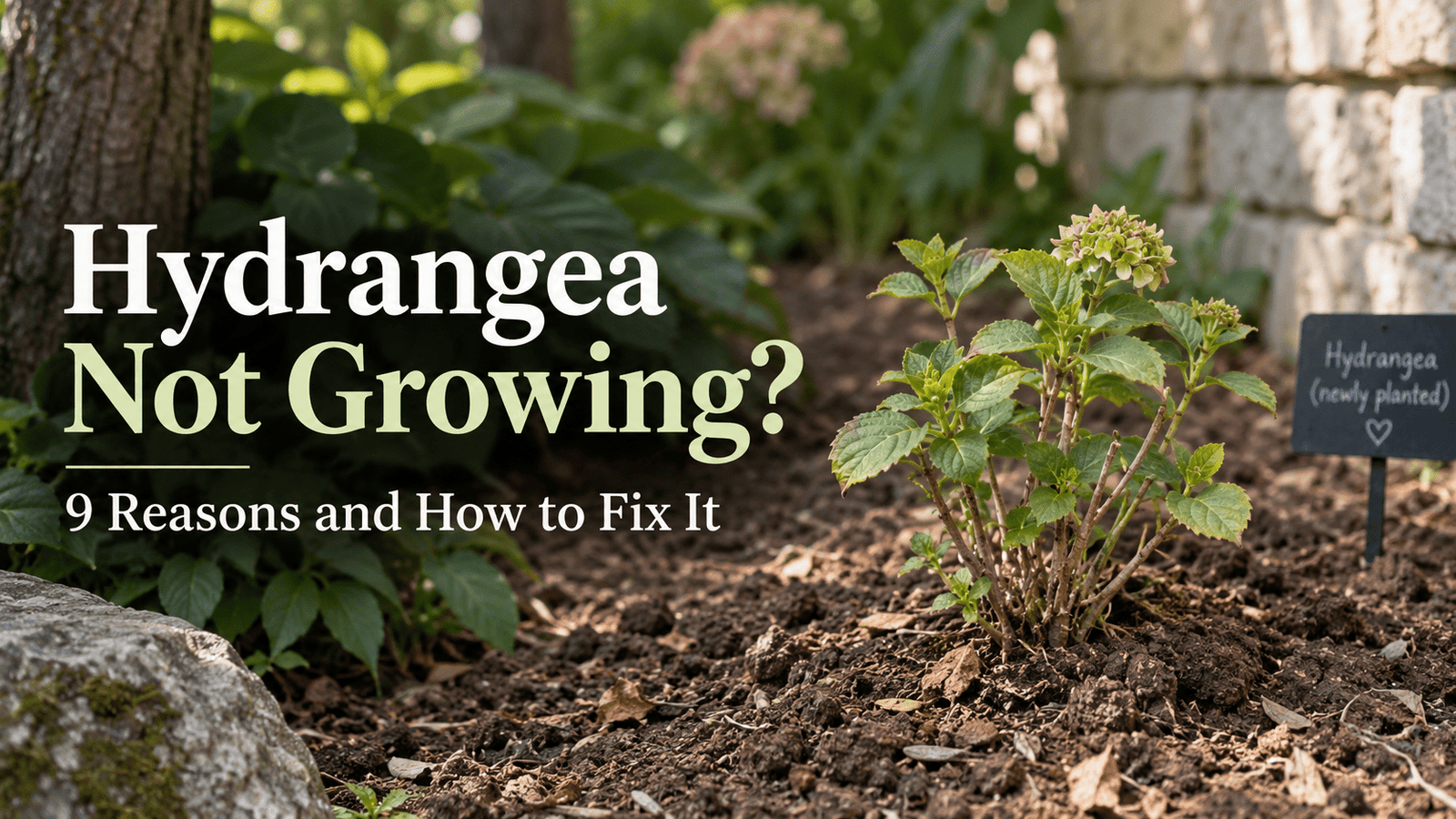
A hydrangea not growing can be frustrating, especially when the plant looks alive but seems stuck at the same size for weeks or even months.
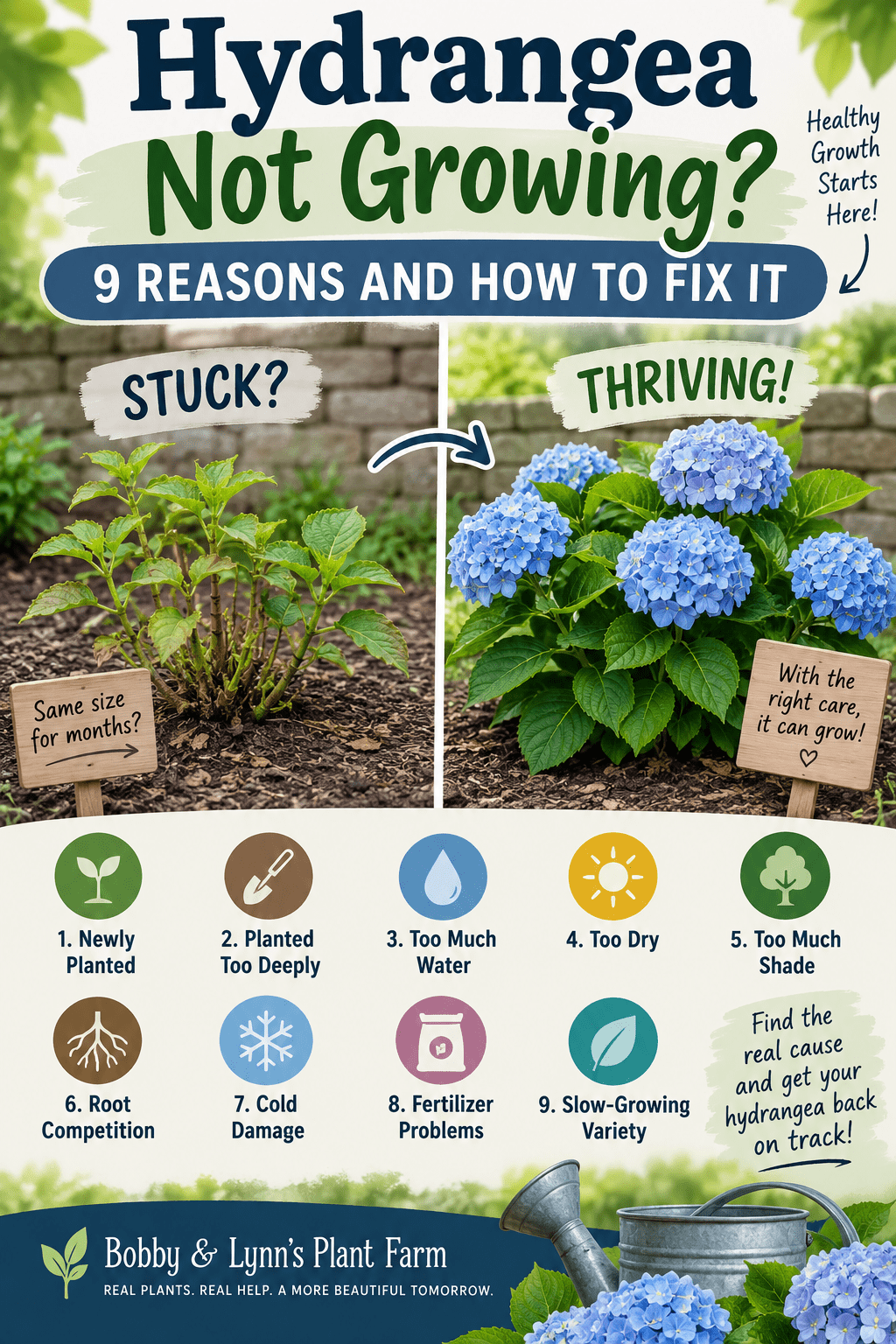
Sometimes the problem is simple. A newly planted hydrangea may just need time to establish roots. Other times, slow or stalled growth can be caused by planting too deeply, poor drainage, too much shade, root competition, inconsistent watering, cold damage, compacted soil, or fertilizer problems.
Here at Bobby & Lynn’s Plant Farm in Dallas, Georgia, we’ve seen hydrangeas sit almost completely still while they adjust to a new planting site, then suddenly begin putting on healthy new growth once the roots get established.
The key is figuring out why your hydrangea is not growing before you start changing everything at once.
Quick Answer: Why Is My Hydrangea Not Growing?
A hydrangea not growing is usually dealing with one or more of these problems:
- It was recently planted and is still establishing roots.
- It was planted too deeply.
- The soil stays too wet.
- The soil gets too dry.
- It receives too much shade.
- The roots are crowded, compacted, or competing with nearby plants.
- Cold weather damaged new growth.
- Fertilizer is missing, excessive, or being used at the wrong time.
- The hydrangea variety simply grows more slowly than expected.
Start by checking the soil, planting depth, sunlight, and whether the plant has been recently transplanted.
Hydrangea Not Growing? Check These Clues First
| What You Notice | Possible Cause | What to Check |
|---|---|---|
| Newly planted but healthy | Root establishment | Give it time and steady care |
| No new growth and buried stems | Planted too deeply | Check root-ball height |
| Yellowing or wilting with wet soil | Poor drainage | Check soil several inches down |
| Crispy edges and dry soil | Not enough water | Water deeply when needed |
| Long weak stems or little growth | Too much shade | Check daily sunlight |
| Stunted plant near large trees | Root competition | Inspect surrounding area |
| Dead tips after winter | Cold damage | Wait for healthy buds to emerge |
| Little growth despite fertilizer | Root or soil problem | Stop adding fertilizer and investigate |
| Healthy but naturally compact | Variety characteristic | Check mature size and growth rate |
1. A Newly Planted Hydrangea May Not Grow Much at First
One of the most common reasons for a hydrangea not growing after planting is that the plant is putting its energy into roots instead of stems and leaves.
That is not necessarily a problem.
A newly planted hydrangea has to adjust from a nursery container to a completely different environment. Soil texture, sunlight, wind, moisture, and temperature may all be different.
During this period, the plant may appear to do almost nothing above ground.
What You Should Do
Keep the soil consistently moist without keeping it saturated.
Avoid heavy pruning and repeated fertilizer applications.
Give the plant time to settle in.
For trees and shrubs, establishment can take much of a growing season, depending on weather and planting conditions. UGA Extension notes that newly planted woody plants often need consistent moisture for an extended establishment period.
If the leaves remain healthy and the stems are alive, slow growth by itself is not always a reason for concern.
2. Planting Too Deeply Can Cause a Hydrangea Not Growing
Planting depth matters more than many people realize.
When a hydrangea is planted too deeply, the roots may struggle to receive enough oxygen.
The base of the plant may also stay wetter than it should.
UGA Extension recommends setting woody landscape plants so the top of the root ball is level with the surrounding soil surface.
Signs Your Hydrangea May Be Too Deep
Look for:
- Soil piled against the main stems
- Mulch covering the crown
- Slow or weak growth
- Yellowing leaves
- Constantly damp soil around the base
- Stem decline near ground level
What You Should Do
Carefully pull excess mulch and loose soil away from the base.
You should be able to see where the stems emerge from the root ball.
If the entire root ball was buried well below grade, correcting the planting depth may be necessary.
Do not yank an established shrub out of the ground during extreme summer heat unless the plant is in serious decline.
3. Too Much Water Can Stop Hydrangea Growth
Hydrangeas like moisture, but they do not like waterlogged roots.
If the soil stays wet for long periods, roots can lose access to oxygen.
A plant with damaged or struggling roots may stop growing even though it still has leaves.
Symptoms can include:
- Little or no new growth
- Yellow leaves
- Wilting despite wet soil
- Leaf drop
- Weak stems
- Dark or declining roots
- Soil that remains muddy for several days
UGA Extension warns that poorly drained, waterlogged soils can suffocate plant roots and seriously interfere with growth.
What You Should Do
Check the soil several inches below the surface before watering again.
Look for drainage problems such as:
- Downspouts emptying near the plant
- Low spots in the landscape
- Heavy compacted clay
- Automatic irrigation running too frequently
If the soil is still wet, do not add more water.
4. A Hydrangea Not Growing May Be Too Dry
The opposite problem can also slow growth.
Hydrangeas have relatively high moisture needs, especially while establishing.
If the root ball repeatedly dries out, the plant may use most of its energy simply trying to survive.
Growth can slow dramatically.
Watch for:
- Wilt that continues into the morning
- Crispy leaf edges
- Dry soil below the surface
- Small new leaves
- Little stem extension
- Leaf drop during hot weather
What You Should Do
Water deeply rather than giving the plant a small amount every day.
Check the soil before watering.
For a more detailed guide, read our Why Hydrangeas Wilt and How to Save Them Fast.
Helpful Watering Tools
If you have trouble judging moisture around newly planted shrubs, a soil moisture meter or a good watering wand can make checking and watering easier.
You can browse the garden tools we recommend in our Amazon storefront.
As an Amazon Associate, we may earn from qualifying purchases.
5. Too Much Shade May Be Why Your Hydrangea Is Not Growing
Hydrangeas are often described as shade plants, but too much shade can reduce both flowering and growth.
Bigleaf and oakleaf hydrangeas often do well with morning sun and afternoon shade.
Deep shade, however, may produce:
- Thin stems
- Sparse growth
- Long stems leaning toward light
- Few flowers
- Smaller leaves
- Slow overall development
UGA Extension recommends morning sun with afternoon shade for bigleaf hydrangeas and notes that they perform best in moist, well-drained soil.
What You Should Do
Observe the area throughout an entire day.
Do not judge sunlight based only on what you see at one particular hour.
Trees and shrubs may also create more shade as they mature.
A hydrangea that once received good morning sunlight can slowly become shaded over several years.
For more help, read our How to Grow Hydrangeas in Georgia.
6. Root Competition Can Cause a Hydrangea Not Growing
A hydrangea may have decent soil and enough water and still struggle because another plant is taking most of the resources.
Large trees are common competitors.
Their roots can extend far beyond the canopy and compete with hydrangeas for:
- Water
- Nutrients
- Root space
Compacted soil can create a similar problem because new hydrangea roots have trouble expanding into hard ground.
UGA Extension notes that compacted soils can inhibit root growth.
What You Should Do
Look at what is growing around the hydrangea.
If it sits directly beneath a mature tree, close to large shrubs, or beside heavily compacted soil, root competition may be part of the problem.
Do not aggressively cut large tree roots just to help the hydrangea. That can damage the tree and create additional problems.
Sometimes a better planting location is the long-term answer.
7. Cold Damage Can Make a Hydrangea Look Like It Stopped Growing
Winter and late freezes can kill stems or damage newly emerging growth.
The plant may survive but need time to rebuild.
You may notice:
- Dead stem tips
- Buds that fail to open
- New growth only near the ground
- Healthy lower stems with dead upper portions
- Slow spring growth
Do not assume the entire shrub is dead.
Wait until active spring growth begins before deciding which stems need to be removed.
Scratch a small area of bark with your fingernail.
Green tissue beneath the bark usually means the stem is still alive.
Cold damage is particularly noticeable on some bigleaf hydrangeas.
8. Fertilizer Problems Can Cause a Hydrangea Not Growing
When a hydrangea is not growing, it is tempting to immediately add fertilizer.
That is not always the right answer.
A root problem, poor drainage, incorrect planting depth, or lack of sunlight cannot be fixed with fertilizer.
Too much fertilizer can actually create more stress.
On the other hand, a genuine nutrient deficiency can also limit growth.
What You Should Do
Check the other growing conditions first.
If the plant is established, the soil drains well, and there is no obvious root or water problem, a soil test can help determine whether nutrients need adjustment.
UGA Extension recommends soil testing to determine fertilizer and lime needs rather than simply guessing.
What We Use When Fertilizer Is Appropriate
When fertilizer is actually needed, we prefer a slow-release fertilizer because it feeds gradually instead of requiring frequent applications.
We use and recommend Osmocote slow-release fertilizer.
Follow the product label and do not exceed the recommended amount.
If the hydrangea is newly planted, give the plant time to establish before automatically feeding it. UGA guidance for bigleaf hydrangeas advises waiting until plants have begun establishing before fertilizing.
As an Amazon Associate, we may earn from qualifying purchases.
9. Your Hydrangea May Simply Be a Slow-Growing Variety
Not every hydrangea grows at the same speed.
Some varieties become large shrubs relatively quickly.
Others remain compact or grow more slowly.
Before assuming something is wrong, check:
- The hydrangea variety
- Expected mature height
- Expected mature width
- Growth habit
- How long the plant has been in the ground
A dwarf hydrangea may be growing normally even though it looks small compared with a Limelight or another large panicle hydrangea.
Likewise, a plant in its first year may grow much less than the same variety after it becomes established.
What We See at Bobby & Lynn’s Plant Farm
When someone tells us they have a hydrangea not growing, one of the first questions we ask is how long it has been planted.
New plants are often simply establishing roots.
After that, we look at moisture and planting depth.
In our Georgia clay, we can have two completely different problems only a few feet apart. One hydrangea may stay too wet because water collects around it, while another may dry out quickly because its original root ball is sitting above or differently from the surrounding soil.
We also see plants placed beneath mature trees where the hydrangea is competing for both sunlight and moisture.
That is why we like to diagnose the growing conditions before adding fertilizer or moving the plant.
Hydrangea Not Growing? What to Check First
Use this checklist before making major changes:
- Find out how long the hydrangea has been planted.
- Check the planting depth.
- Check the soil several inches below the surface.
- Look for standing water.
- Check whether the root ball is drying out.
- Measure how much sunlight the plant actually receives.
- Look for nearby tree roots or heavy competition.
- Check stems for winter or freeze damage.
- Review any fertilizer recently applied.
- Confirm the mature size and growth habit of the variety.
Change one or two things at a time.
If you change watering, fertilizer, sunlight, and planting depth all at once, it becomes difficult to know which problem actually mattered.
What Not to Do When Your Hydrangea Is Not Growing
Avoid these common reactions:
- Don’t automatically add fertilizer.
- Don’t water every day without checking the soil.
- Don’t assume every hydrangea needs deep shade.
- Don’t cut the entire shrub back just because growth is slow.
- Don’t bury the plant under several more inches of mulch.
- Don’t move a newly planted hydrangea repeatedly.
- Don’t expect every variety to grow at the same rate.
- Don’t give up on a healthy plant after only a few weeks.
Frequently Asked Questions About a Hydrangea Not Growing
Why Is My Newly Planted Hydrangea Not Growing?
The plant may be establishing roots instead of producing much top growth.
Keep the soil evenly moist, avoid heavy fertilizer, and give the hydrangea time to adjust.
Why Is My Hydrangea Alive but Not Getting Bigger?
Check sunlight, soil moisture, drainage, planting depth, root competition, and variety.
A plant can remain alive for quite a while under less-than-ideal conditions while producing very little new growth.
Can Too Much Water Stop a Hydrangea From Growing?
Yes.
Constantly wet soil can reduce oxygen around the roots and interfere with healthy root function.
Check the soil before watering again.
Can Too Much Shade Cause Slow Hydrangea Growth?
Yes.
Some hydrangeas tolerate shade well, but deep shade can reduce growth and flowering.
Morning sun with afternoon protection works well for many bigleaf hydrangeas.
Should I Fertilize a Hydrangea That Is Not Growing?
Not automatically.
First check planting depth, drainage, water, sunlight, and root health.
If those conditions look good, consider a soil test before adding fertilizer.
How Long Does It Take a Hydrangea to Start Growing After Planting?
Some plants begin producing new growth quickly, while others spend much of their first season establishing roots.
Weather, planting time, root condition, soil, and variety all affect how quickly growth begins.
Why Is My Hydrangea Growing From the Bottom but Not the Top?
Cold damage may have killed the upper stems while the root system survived.
Wait for spring growth to make it clear which stems are alive before pruning heavily.
Hydrangea Not Growing and Not Blooming?
Slow growth and missing flowers can happen together, but they are not always caused by the same thing.
If your hydrangea is producing healthy leaves but no flowers, pruning timing, cold-damaged flower buds, shade, and excess nitrogen may be more important than overall growth.
Read our guide to why hydrangeas are not blooming for a complete troubleshooting checklist.
Get More Hydrangea Help
If your hydrangea needs more than one adjustment, our Hydrangea Care Guide covers watering, pruning, sunlight, blooming problems, and common leaf issues.
You can also use the free Garden Help app at OurPlantFarm.com/app for quick plant-care tools and reminders.
Final Thoughts: Hydrangea Not Growing
A hydrangea not growing does not necessarily mean the plant is failing.
Start with the basics: planting depth, soil moisture, drainage, sunlight, root competition, and how long the hydrangea has been in the ground.
Newly planted shrubs often need patience. Established hydrangeas that suddenly stop growing deserve a closer look at their roots and growing conditions.
Most importantly, resist the urge to throw fertilizer or extra water at the plant before identifying the cause.
Once you figure out what is holding the hydrangea back, you can make the right correction and give it a better chance to start growing again.
Discover more from Bobby and Lynn’s Plant Farm
Subscribe to get the latest posts sent to your email.